Nike introduced two shoes this month built for hybrid fitness racing. The Hybrid RN launches in China on September 24 and globally on October 8, with the Hybrid Fly, a carbon-plated race shoe, following in April 2027. Lauren Weeks, a Nike-sponsored athlete and 2026 HYROX Doubles World Champion, framed the design problem plainly: hybrid asks more of a shoe than road running does.
Nike is late. Puma has been HYROX's official footwear and apparel partner for years and extended through 2030, with its CEO describing the relationship as a lighthouse partnership central to the brand's 2026 strategy. Adidas has been reported as circling.
The footwear fight is the visible part. The interesting part is everything else that has quietly attached itself to this format.
Where does a gym actually make money from HYROX?
Not from the affiliation. The fee buys you the badge and the network, and it generates nothing on its own. Gyms earn on what the affiliation lets them sell: multi-week race preparation blocks, small-group technique work on specific stations, pacing clinics, and the retention effect of members training toward a dated goal. A member with a race on the calendar has a reason to hold their membership through the whole training cycle, which is worth more than the block itself.
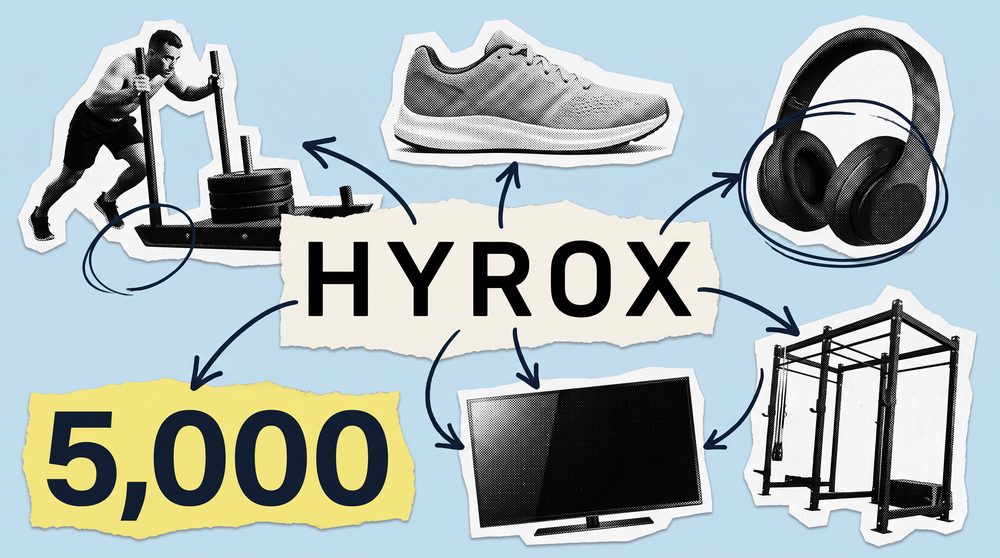
The ecosystem, layer by layer
Here is what has assembled around a format that did not exist commercially a decade ago.
| Layer | Who owns it | What a gym can sell against it |
|---|---|---|
| Footwear and apparel | Puma (official, through 2030), Nike (entering Oct 2026) | Nothing directly. Retail margin at best. |
| Audio and accessories | Shokz (official headphone partner) | Nothing directly. |
| Broadcast | Atmosphere TV, carrying Majors and Regional Championships to 60,000+ venues | Watch parties, community nights, local visibility. |
| Events and regional sponsorship | HYROX plus title sponsors (Masters' Union, AirAsia) | Team entries, travel groups, club identity. |
| Training | 5,000+ affiliated gyms, roughly $1,500/year per site | Race prep blocks, station clinics, coaching, retention. |
Read the right-hand column top to bottom. Four of the five layers are closed to an independent operator. Nobody is going to outbid Puma. The fifth layer is the one nobody else can serve, because a global brand cannot coach someone through their first sled push in a specific neighbourhood on a Tuesday.
The brands are competing to sell athletes gear. Nobody is competing with you to sell the twelve weeks before race day.
— The Run RateWhat affiliation costs and what it does not buy
A HYROX Training Club is an affiliated gym licensed to run official HYROX-branded training and appear in the network's gym finder. Reported pricing puts it at roughly $1,500 per year per site in the US, with UK and EU sites quoted around £90 or €90 per month, and the entry tier does not impose a square footage minimum or an equipment quota. Reported affiliate counts vary by source; the figure with the best sourcing behind it is more than 5,000 gyms globally, and HYROX expects participation to pass two million athletes in the 2026/27 season.
At $1,500, the arithmetic is not complicated. One member joining specifically to train for a race covers the year. That is a low bar, and it is why the affiliation decision is usually not the hard part. The hard part is that a badge on the door does nothing by itself. Athletech has reported HYROX-related sales at gyms up 191% year over year, drawn from Mindbody's transaction data, with new customers up 154%. The full piece sits behind Athletech's Pro paywall and Mindbody's sample and time period are not public, so treat the size of those numbers as directional. The composition is what you can act on. Most of the growth is arriving as new people walking in, which makes race demand an acquisition channel and prices the affiliation accordingly.
The pattern this fits
We wrote in July about BFT running its Podium Series and effectively turning the gym floor into a ticketed venue. HYROX is the same insight at industry scale, with the difference that HYROX owns the event and you rent access to its gravity. That is a worse deal on paper and a better one in practice, because the marketing is already done. Two million people are looking for somewhere to train.
It also sits neatly on top of a shift we have tracked twice now. Strength has overtaken weight loss as the stated top goal for a plurality of gymgoers, which is why we argued your intake form should be capturing that at the baseline. Hybrid racing is what a strength-first member does with that goal once they want it measured. The same logic drove the rucking piece, where the on-ramp mattered more than the format.
The practical move is unglamorous. Decide whether you want the badge, then build the twelve-week block before you buy it, not after. The affiliation is the cheapest line item in this entire ecosystem. The programming is the part that earns.