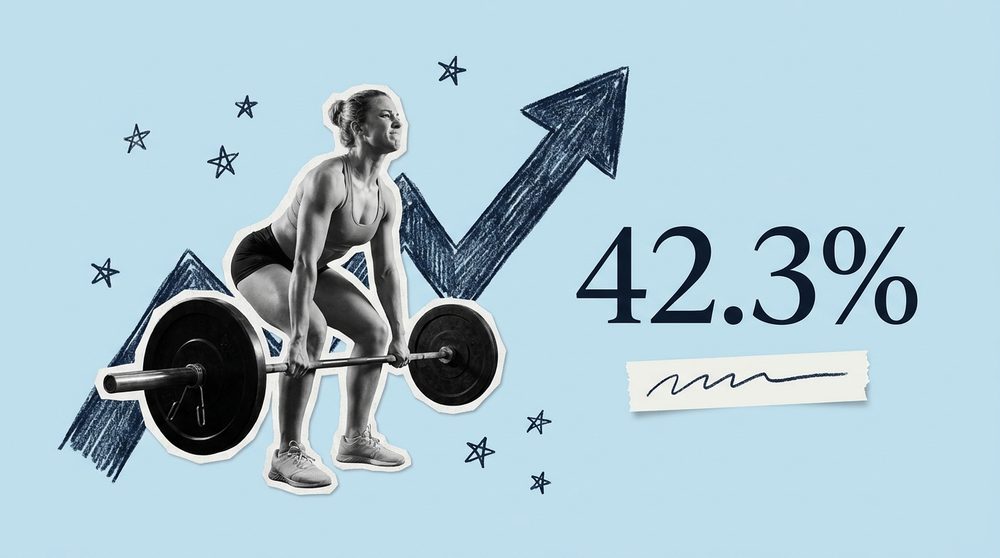
For the past year, the shift from weight loss to strength has been something operators could feel but not prove. Trainers reported it. Intake forms hinted at it. We made the case in June that studios needed to retool for it. What was missing was a number. Now there's one. In a survey of 750+ people on 2026 fitness intentions, 42.3% named getting physically stronger as their top goal, and 46.5% said they plan to lift more weights this year. Weight loss, the industry's default product for four decades, is no longer the top request.
Read the figure with the caution any single survey deserves. This is a self-selected sample of an enthusiast-skewed readership, closer to a temperature check than a census. But a temperature check still tells you which way the room is heading, and this one points the same direction as everything else in the market. The same respondents ranked longevity and healthy aging above aesthetics, the pattern already visible in wearable adoption, in recovery spending, and in where venture money is going.
The easy story is that GLP-1s (glucagon-like peptide-1 receptor agonists, the drug class behind Ozempic, Wegovy and Mounjaro) did this. They are part of it, but they arrived late. The strength shift has been building for years on the back of longevity culture, as grip strength and muscle mass crossed from exercise-science journals into everyday conversation and VO₂ max made the pages of Vogue. What the drugs added was urgency from two sides at once. They took the old weight-loss job off the gym entirely, since a member chasing a scale number can now reach it at the pharmacy. And they created a new one, because fast drug-driven weight loss strips muscle along with fat. In New Zealand, at 10.2% GLP-1 adoption, the industry body Exercise NZ is already urging that the drugs ship with a resistance-training warning.
What does a survey like this actually change for operators?
On its own, not much. Operators who were paying attention already knew strength was rising. What a hard number changes is what you can justify. Instinct doesn't get budget approved, doesn't win an argument with a skeptical co-owner, and doesn't reset a marketing calendar. A figure like 42.3% does. It turns 'I think members want strength now' into a planning assumption you can spend against, and it moves the strength pivot from something you defend to something you simply decide.
The one move: rewrite the intake conversation
If the number changes one thing in your studio this week, make it the goals form. Whatever a member writes down at signup becomes the contract they measure the membership against. When that's a scale number, you have promised an outcome a pharmacy now delivers for less than your monthly dues. So change what you record. Give every new member a strength baseline instead: a starting lift or hold you assess on day one, a score they can watch climb, a result that only shows up with training. It costs almost nothing to roll out, and it quietly re-points every future check-in at progress a drug can't manufacture.
| Scale-number intake | Strength-baseline intake | |
|---|---|---|
| What you record at signup | A target weight | An assessed starting strength |
| What the member is judged on | A number the scale controls | A number training controls |
| Who else can deliver it | A pharmacy, cheaper | Only your coaching |
| What each check-in points at | Pounds lost or not | Strength gained, visibly |
There's a longer game underneath this. As measuring the body gets cheaper and more automated, the value moves to whoever interprets the measurement, the same dynamic that had Eli Lilly buying a piece of Oura. A strength baseline is a measurement. The coach who tells a GLP-1 user what to do about their muscle loss is the interpretation, and that is the part of a studio nothing else in the member's life replaces. Studios are well placed to own it. Most simply haven't claimed it yet.
The survey put a number on something operators had already sensed. What it added was permission to act, and a figure to act with. The studios that come through this transition will be the ones that change what they measure before their members change gyms.