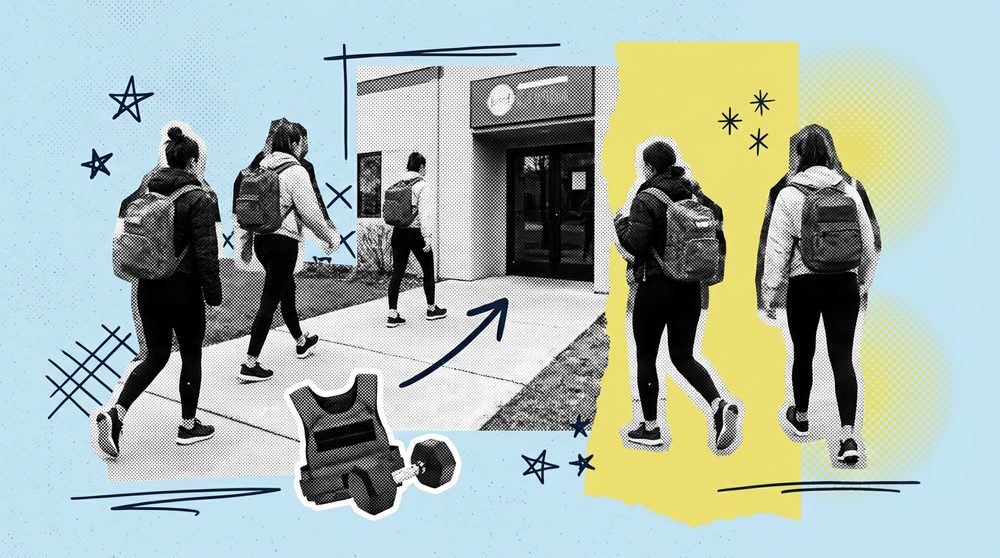
Rucking is the walking workout with weight on your back, and in 2026 it is the fastest-growing on-ramp into strength. GORUCK, the brand that turned military rucksacks into a fitness category, reports sales up around 40 percent, and its co-founder says women are now its fastest-growing customers. Retail data tells the same story from a different shelf, with weighted-vest sales up roughly 50 percent year over year to about $27 million. Forbes and Newsweek both trace the trend to the same place: women who want to get stronger without walking into a weight room to do it.
Operators have seen this movie before. A few years ago the run club went from a free Saturday habit to one of the most reliable community and acquisition engines in fitness. Rucking is the same opening pointed at strength instead of cardio, and most gyms and studios are watching it happen on the sidewalk instead of running toward it.
Why are women driving the rucking boom?
Because it removes the two things that keep women out of the weight room. The first is intimidation. A backpack and a walk feel nothing like a barbell in a room of grunting men. The second is the fear of doing it wrong. Rucking is close to impossible to mess up, so there is no learning curve to survive before you feel competent. Add a starting load of eight to twenty pounds, a social pace, and the fact that mixed-ability groups can train together, and you get strength that feels approachable and looks like a conversation.
That approachability is a quiet indictment of how most strength offerings are sold. The weight room, the reformer, the small-group strength class, all of them still carry a learning curve and an unspoken assumption that you already know what you are doing. We have written before about how the industry defaults to a male customer and then wonders why half the market stays away. Rucking is what happens when a format accidentally gets the on-ramp right. It meets a beginner where she is, and it lets her build an identity as someone who trains before anyone hands her a program.
This is a top of funnel (the widest, earliest stage of acquisition, where someone first tries a category) that gyms and studios do not have to invent. The demand already exists and it is walking past your front door with a loaded pack. The strategic move is to own the entry point rather than cede it to a backpack and a YouTube video. It fits the same shift we tracked when strength replaced weight loss as the top member goal and when 42.3 percent of exercisers named strength their number one priority.
Three ways into strength, and why the on-ramp wins
A beginner who wants to get stronger has three realistic paths. Two of them lose most people before they build a habit. The third is the one operators can own.
| DIY from YouTube | Straight to a trainer | Approachable on-ramp | |
|---|---|---|---|
| Cost | Free | High | Low |
| Intimidation | Medium | High | Low |
| Good form early | Unlikely | Likely | Likely with light guidance |
| Odds they stick | Low | Medium | High |
The floor move for gyms: a roaming form fixer
Here is a cheap, high-trust upsell most gyms are leaving on the table. Put a coach on the floor whose only job for an hour is to walk the room and offer small corrections, a cue on posture here, a tweak to a hip hinge there. No session booked, no pressure. For a nervous beginner, that thirty seconds of help is the difference between quitting and coming back, and it shortcuts the grim choice between teaching yourself from videos or committing to a block of paid sessions before you know if you even like it. The form fixer is a sample of what good coaching feels like, and sampling is how you sell the real thing.
Rucking is doing for strength what the run club did for cardio. The demand is already outside your door with a loaded pack.
— The Run RateFor studios, the same demand becomes a class. An approachable-strength or ruck-based format is a legitimate front door, a lower-stakes entry rung that graduates people into structured strength programs or your existing classes once they have the confidence and the habit. Whether you run a big-box gym or a boutique studio, it is the same idea in different clothing, a way to convert the intimidated majority into members who train.
The mistake would be to treat rucking as a fad to wait out. The trend will fade as a hashtag. The underlying demand, from women and beginners who want strength without the intimidation tax, is not going anywhere. The operators who build the on-ramp now will own the relationship long after the backpack stops trending.