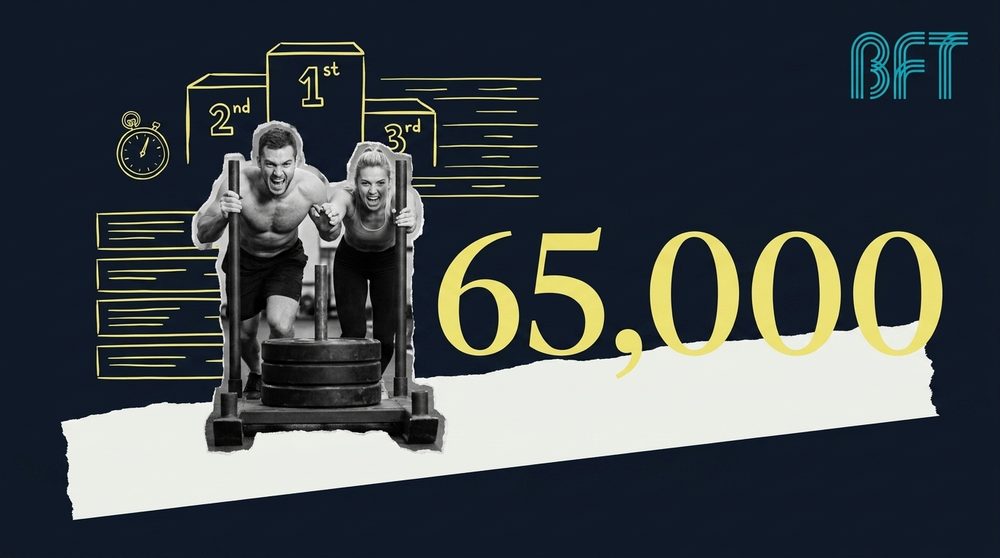
On August 2, more than 65,000 members across 300+ Body Fit Training studios in over 10 countries will compete in the same event on the same day, tracked on one live leaderboard. BFT's new Podium Series puts teams of two through four 15-minute zones (strength, conditioning, strength endurance, and a finisher) across Rookie, Open and Pro tiers. Registrations opened June 15 and close July 26. Skip past the format for a second, because the economics are the real story. Franchisees keep 100% of ticket sales, plus whatever they earn on local sponsorships, merchandise, and event-day food and beverage.
The category context is what makes this a story rather than a franchise press release. HYROX grew from 570,000 athletes to 1.5 million in a single season, with races expanding from 74 to 105 and more than two million expected next season. At that scale, competitive fitness has become one of the most proven consumer behaviors in the industry. So the question worth asking is a different one. When people pay to compete, who captures the revenue?
Until now, the dominant answer was the race brand. The affiliate model, which we anatomized in Spartan's Deka version, has studios recruiting their own members into someone else's event, running the local marketing, and collecting a trophy for taking part. The studio generates the demand while the brand keeps the economics. BFT's Podium Series is the first major franchise model to run the other direction. Build the race inside the studio's own four walls, and let the operator keep the gate.
| Renting the demand (race-brand affiliate) | Building it (Podium model) | |
|---|---|---|
| Who owns the event | The race brand | The studio |
| Ticket revenue | Goes to the race brand | 100% to the franchisee |
| Who runs the marketing | The studio, for the brand | The studio, for itself |
| Sponsors, merch, F&B | Brand-controlled | Studio-controlled |
| What the studio keeps | Affiliation and a trophy | Revenue, plus prospects in the room |
How do in-studio competitions make money for franchisees?
Four stacked revenue streams, all landing on the studio's P&L: ticket sales (100% retained under BFT's model), local sponsorship sold against a captive event audience, merchandise, and event-day food and beverage. On top of that direct revenue sits the acquisition effect, as spectators and competing non-members see the studio at its most energized. Founder Cameron Falloon claims live events convert prospects better than traditional marketing. He hasn't published conversion data to back it, so treat that as a founder's claim. The structural point holds regardless. The event pays for itself before it converts a single member.
That shift is the real headline. Studio events have always existed, but as a marketing expense justified by hoped-for sign-ups. Podium-style competition moves the event onto the revenue line and treats acquisition as a bonus on top. It's the same migration we traced in recovery's move from amenity to revenue stream, where things studios used to give away got priced and sold. Ancillary revenue (income from anything other than the core membership, like events, retail, recovery and F&B) is quietly becoming the margin story in boutique fitness, because membership pricing stays competitive while rent never negotiates.
What can independents copy without 320 locations?
Almost all of it. The 65,000-member simultaneous leaderboard is franchise-scale theater, impressive and mostly irrelevant to the unit economics. What makes the model work at a single location is the format, and the format is easy to copy. Run it in teams of two, which halves the intimidation barrier and doubles the invite reach since every member brings a partner. Add tiered divisions so beginners aren't stuck competing against the front row. Use time-boxed stations any coach can program, a live leaderboard, and a date on the calendar with tickets attached. One studio running that twice a year and selling its own sponsors (the local physio, the supplement shop, the smoothie bar) captures the same economics BFT just systematized, at the scale it actually operates.
HYROX proved the demand. Spartan proved studios will hand it away for a plaque. BFT just proved the obvious third option: charge for it yourself.