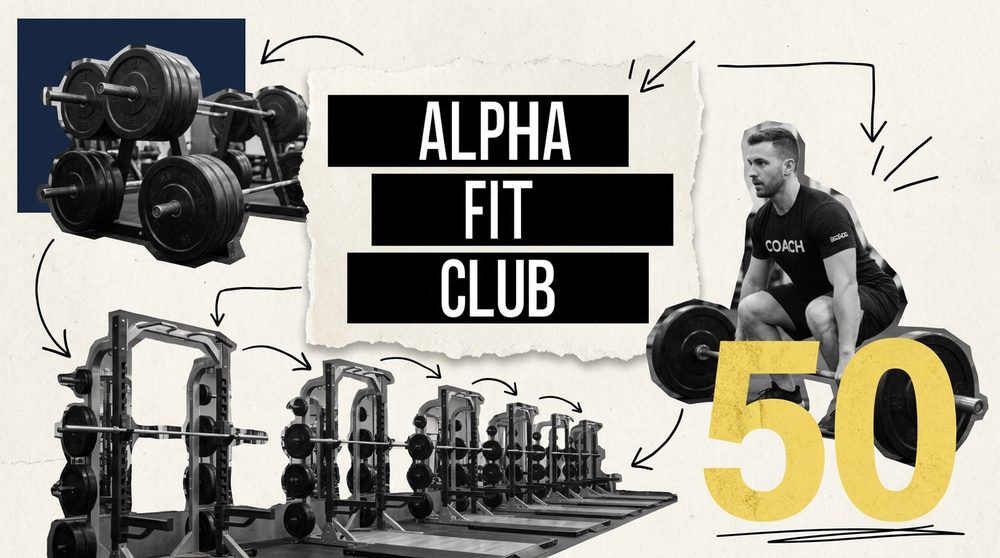
Alpha Fit Club is at 20 studios. It wants roughly 30 by the end of 2026 and 50 by mid-2027, pushing out of its New Jersey base into Connecticut, New York, Pennsylvania and Florida. To get there, founder and CEO Sam Tooley has signed an exclusive partnership with PLAE to standardize equipment and programming across every new location, as reported by Club Solutions.
In the same week, a company operating 31 F45 studios across six states filed for Chapter 11.
Those two facts belong in the same paragraph, because they describe the same problem from opposite ends.
What Alpha is actually buying
Tooley frames the deal as experience. "Growth only matters if the experience improves along with it," he told Club Solutions. The contract is the operational version of that sentence, fixing what a member walks into before a franchisee has an opinion about it.
For a premium concept that matters more than it does at the budget end. Unit economics (the revenue, cost and margin profile of a single location) in premium fitness depend on a member believing the price is justified within ninety seconds of walking in. Equipment quality is the fastest visible proof available, and the first line a cash-tight franchisee will cut. Removing that decision from them protects the whole network.
Variance is what kills a premium brand at scale. Standardization is the instrument that removes it.
— The Run RateDoes standardizing equipment make a premium franchise less premium?
No. Standardization removes variance, and variance is what breaks premium positioning at scale. A member paying a premium rate expects the same equipment, programming and coaching quality in Hartford as in Hoboken. When a franchisee substitutes cheaper racks or improvises the programming, the brand promise fails at that location and the damage travels across the whole network through reviews and word of mouth. Locking the specification makes the premium claim defensible in every market, not only in the founder's original studios.
This is where the franchising conversation usually runs backwards. Operators treat standardization as a dilution of the concept, accepted in exchange for growth capital. Alpha is treating it as the product being franchised: a specification detailed enough that a franchisee cannot accidentally build something worse.
What the specification covers, and what it leaves exposed
| Standardized by the PLAE deal | Still owned by the franchisee |
|---|---|
| Equipment specification and floor layout | Site selection and lease terms |
| Programming methodology | Coach hiring quality and retention |
| Physical member experience | Local marketing and pre-sale performance |
| Brand consistency across markets | Working capital and runway |
The right-hand column is where franchises die.
The sequence that produced the F45 filing
Alpha launched franchising in 2022 and sold 20 franchises before opening a single franchised location. That sequence is normal in boutique fitness, and it is the sequence that produced the situation now sitting in a Florida bankruptcy court.
Mad Fitness Group, based in Pinecrest, Florida, filed a Subchapter V petition alongside 31 affiliates in the Southern District of Florida on August 9. It ran 31 F45 studios across six states and listed assets and liabilities in the same narrow band of $100,000 to $500,000. It had already vacated 15 studios before filing, including sites in Miami, suburban Maryland and metro Atlanta, and told the court it intends to reorganize around the locations that can pay their own way, according to TheStreet's account of the filing.
The franchisor was not the thing that broke. F45 Training Incorporated is not part of the filing. The multi-unit operator broke, holding 31 studios and under half a million dollars in listed assets.
Equipment standardization does nothing about that. It governs what a studio feels like, not whether a franchisee has the capital to absorb a soft quarter. We looked at the capital half of this problem in our piece on how Pilates brands are using master franchising to scale without their own balance sheet, and at the counting problem in Xponential's Q2, where studio count rose while revenue per studio fell.
How should independent operators read this?
You do not need a franchise system to use the lesson.
Write the specification you would never let a second location break. Equipment, class structure, coach onboarding, the first-week member sequence. Most operators keep this in their heads and nowhere else, so it degrades the moment they hire someone new.
Separate what scales cheaply from what does not. Equipment is a purchase order. Coaching quality is a hiring and development system, and it is the real constraint on how fast you can open. Crunch buying back franchisee territory before rolling out Crunch 3.0 is the same admission at a larger scale.
Underwrite each location on its own. The F45 filing describes a portfolio that was never allowed to shed a bad unit until 15 had to go at once. A location that cannot pay for itself inside its ramp window is a decision waiting to be made.
Alpha's bet is that a tighter specification makes the franchise more valuable, not less. On the evidence filed in the Southern District of Florida this week, that looks like the right bet.