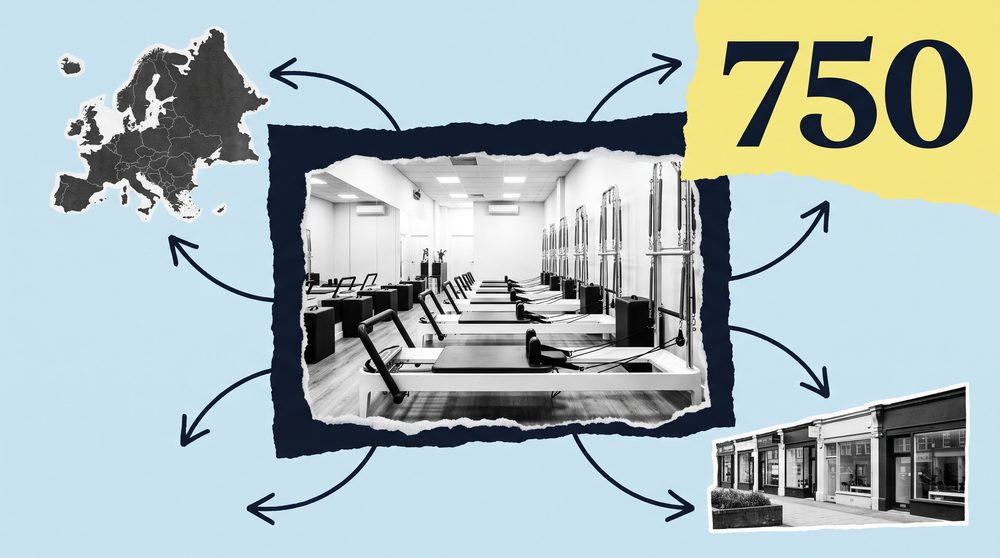
STRONG Pilates announced on August 3 that it had signed a master franchise partnership with Xtreme Brands, taking the Australian brand into Poland and the Czech Republic with plans across ten European countries. STRONG becomes the first outside brand in the Xtreme portfolio.
The numbers on both sides explain the deal better than the press release does. STRONG, founded in Australia in 2019 by Michael Ramsey and Mark Armstrong around its Rowformer and Bikeformer equipment, has more than 120 studios across 15 countries, over 57,000 members, and 200-plus locations in development. Xtreme Brands runs 181 Xtreme Fitness Gyms in Poland, is adding roughly three clubs a week, and is targeting 750 locations across Central and Eastern Europe by 2030.
One of those companies has a brand that travels. The other has the sites, the crews and the local knowledge to open three of anything a week.
What does a brand give up in a master franchise deal?
Direct control of the member experience across an entire territory, and the ability to fix problems quickly. A master franchise grants one partner the rights to develop and sub-franchise a brand across a whole country or region, funded by that partner. The brand gains geographic scale without deploying capital or building a local team. In exchange it accepts that its equity in that market now depends on someone else's execution, someone else's site selection, and someone else's priorities among the other brands they operate.
Why this model is doing the heavy lifting right now
Reformer studios are capital intensive. Equipment, buildout and the square footage to hold both are real money per site, and the category is scaling faster than most brands can self-fund. Master franchising solves that by moving the funding to whoever already has the balance sheet in-market.
It is not a STRONG-specific play. Club Pilates reached 1,500 studios worldwide partly on the back of master agreements, with recent openings in Bangkok and Mexico City and a master deal signed for the Philippines. Xponential's President of International, Bob Kaufman, has made the point directly: very few franchise brands travel at all, and the ones that do adapt locally.
You are buying speed with a currency called control, and the exchange rate is fixed the day you sign.
— The Run RateThe trade, laid out
| Direct expansion | Master franchise | |
|---|---|---|
| Capital required from brand | High | Minimal |
| Speed to territory scale | Slow | Fast |
| Control of member experience | Full | Delegated |
| Local real estate and regulatory knowledge | Must be built | Comes with the partner |
| Revenue per location to brand | Full royalty | Shared with master |
| Cost of a bad partner | Not applicable | An entire region |
That last row is the one brands underweight. Replacing a single underperforming sub-franchisee is an unpleasant quarter. Unwinding a master agreement across a country is a multi-year problem, and during it your brand is being represented by a partner you are in dispute with.
What operators should take from this
If you are a single or multi-site operator, the relevance is in what it tells you about the competitive weather. Formats are now arriving in markets fully funded and at pace, not one storefront at a time. A brand that had zero presence in your city eighteen months ago can have six studios in it, because the capital and the construction capacity were already there and only the brand had to be imported.
There is also a caution embedded here, and it connects directly to what we wrote about Xponential's second quarter. Master franchising accelerates the store count. It does not do anything for average unit volume, and it can work against it if the partner prioritises openings over density economics. Speed of expansion and health of individual units are separate measurements, and the model that maximises the first has no built-in mechanism for protecting the second.
The counterexample is worth holding in mind too. Basic-Fit spent years opening clubs at pace and then deliberately stopped building and pivoted to efficiency. Every expansion story eventually gets there. The question is whether the brand chooses the moment or the numbers choose it.
And if Pilates is your category, the strategic frame matters more than the news. Pilates stopped being a workout and became a business model, and business models get bought, franchised and rolled out by people whose expertise is franchising rather than Pilates. Plan for a well-capitalised, professionally operated competitor. Not an enthusiast opening one studio.