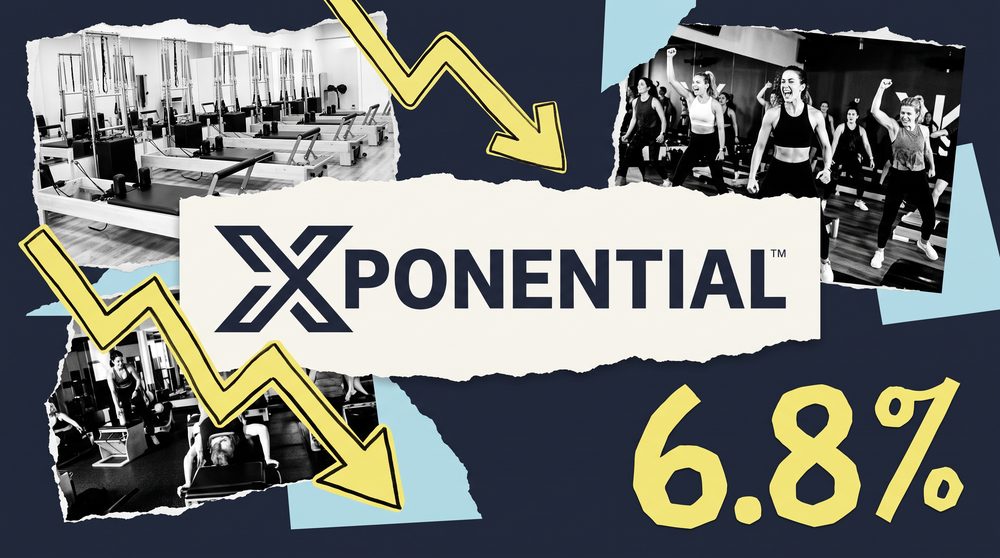
Xponential Fitness reported its second quarter on August 6, and the numbers are worth reading slowly. Revenue came in at $66.0 million, down 13% year over year. The company posted a net loss of $4.8 million, against $1.3 million of net income in the same quarter last year. North America same-store sales fell 6.8%, compared with growth of 2.4% a year earlier. Run-rate average unit volume slipped to $659,000 from $686,000.
Two days earlier, Club Pilates, an Xponential brand, announced it had passed 1,500 studios worldwide, on the back of openings in Bangkok and Mexico City. Bob Kaufman, Xponential's President of International, called out how few franchise brands reach even 100 locations.
Both announcements are accurate. They are also measuring two different businesses.
What does a falling AUV mean for a franchisee?
AUV (Average Unit Volume) is the annual revenue a single average location produces. It is the number a franchisee actually lives on, because royalties, rent, payroll and marketing fees are all sized against it. A $27,000 drop in AUV lands almost entirely in the operator's margin, since the fixed costs underneath it do not fall by 4% just because revenue did. System-wide studio count does not appear anywhere in that math.
This is the structural thing worth naming. A franchisor books revenue at the moment a studio opens: franchise fees, equipment packages, territory sales, buildout. A franchisee books revenue over the years a studio operates. For most of the last decade those two lines moved in the same direction, which is why "we passed 1,500 studios" worked as shorthand for system health. This quarter they came apart.
The franchisor gets paid when the studio opens. The franchisee gets paid when the studio fills.
— The Run RateThe quarter in two columns
| Metric | Q2 2025 | Q2 2026 |
|---|---|---|
| Revenue | $76.2M | $66.0M (-13%) |
| Net income / (loss) | $1.3M | ($4.8M) |
| North America same-store sales | +2.4% | -6.8% |
| Run-rate AUV | $686,000 | $659,000 |
| North America system-wide sales | $437.3M | $437.3M (flat) |
Look at the last row against the third. System-wide sales held flat while same-store sales dropped 6.8%. That gap is new studios filling in for existing ones. The system looks stable at the top because the denominator keeps growing.
Xponential also cut its full-year guidance: revenue of $250 to $260 million, adjusted EBITDA of $91 to $97 million, and roughly 150 global net new studio openings. Management pointed to merchandise pressure and more cautious second-half same-store sales assumptions. CEO Mike Nuzzo said results were below expectations while pointing to continued studio growth, digital capability and franchisee support as the priorities. The board is still reviewing strategic alternatives, which includes a sale.
What this means if you are not Xponential
Most people reading this do not own XPOF stock. They own one studio, or three, or they are deciding whether to sign a franchise agreement this year. The useful part is the diligence question set that falls out of this quarter.
Ask for AUV by cohort year, not the system average. A system average blends studios that opened in 2018 into a number quoted to someone opening in 2027. Ask what same-store sales did in the last four quarters in your region specifically, since the 6.8% is a North America figure and regional spread inside that is usually wide. Ask what percentage of system revenue comes from merchandise, because that line moved here and it is the line franchisees have least control over. And ask how many studios closed or transferred ownership last year, a number that rarely makes the milestone press release.
The same discipline applies to your own business even if you never franchise anything. We have written before about how revenue per member becomes the only lever once member growth stalls, and the logic is identical one level up: when you cannot add units, the unit you have has to earn more. Pilates in particular has spent three years being treated as a growth format, and we argued a while back that Pilates had stopped being a workout and become a business model. A business model has unit economics, and unit economics eventually get reported.
None of this makes 1,500 studios a bad outcome. It is a genuine operating achievement and very few brands travel that well. It just is not evidence about whether the studio you are about to open will clear its rent. Those are separate questions, and this quarter is the clearest illustration in a while that they can move in opposite directions at the same time.
If you are pricing your own studio against a franchise alternative, our guide to pricing a boutique studio without racing to the bottom is the other half of this calculation.