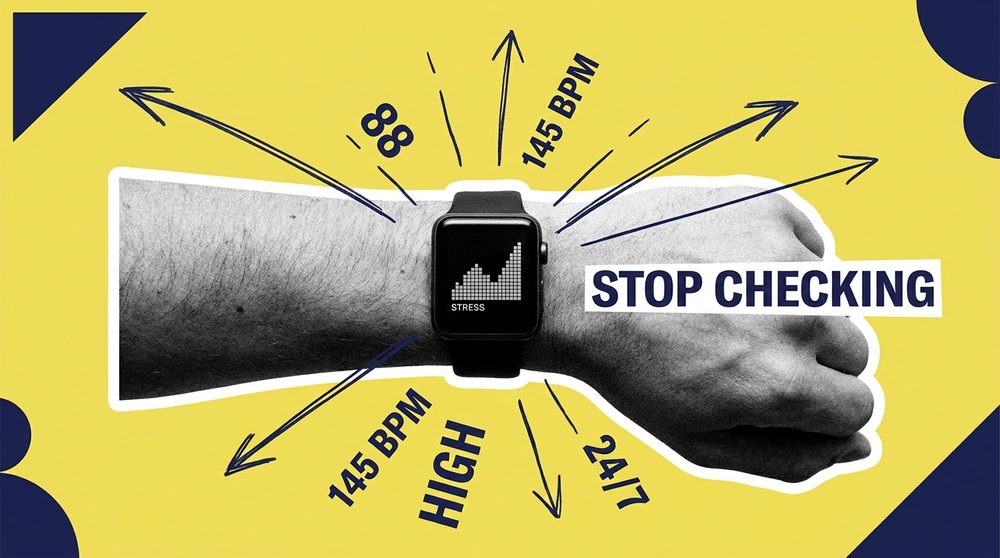
A TikToker recently went viral for building an AI dashboard that cross-referenced his WHOOP stress scores with his work calendar to identify which colleagues were spiking his cortisol the most.
It was funny. It was clever. And it revealed something the fitness industry needs to take seriously: we have built an entire culture around quantifying stress — and done almost nothing to help people actually release it.
What's actually happening
New data from WHOOP, released this week, shows that stress levels spike with remarkable consistency — Sunday evenings, Monday mornings, the 48 hours before a major deadline. The findings made headlines because of how precise they were. But buried in the coverage was a more uncomfortable truth: knowing exactly when you're stressed hasn't made anyone less stressed.
The LA Times put a finer point on it this month. Health trackers, the piece argued, are making a growing segment of users more anxious — not healthier. The problem isn't the data. It's what happens when people have no clear action to take with it. A recovery score of 34% on a Monday morning doesn't tell you what to do. It just tells you something's wrong, in a format you'll check seventeen more times before noon.
We have arrived at peak quantification. WHOOP, Oura Ring 5, Apple Watch Ultra, Garmin, Fitbit Air — every wrist, every finger, every morning, a score. More data than any previous generation of humans has ever had access to. And anxiety rates are climbing.
"The app told them something was wrong. Your coach helped them do something about it."
Why it matters for your studio
This is your opening.
Not because your studio is a therapy clinic or a wellness retreat. But because you offer something none of these devices can: a decision that's already made. The class is at 6am. It's 45 minutes. Someone will tell you what to do when you get there. You will leave feeling different than when you walked in. No dashboard required.
That is genuinely rare right now. And most studios are underselling it.
The fitness industry has spent the last five years trying to integrate wearable data — recovery-aware programming, HRV-informed class intensity HRV: HRV (Heart Rate Variability): a measure of the variation in time between consecutive heartbeats, widely used by wearables like WHOOP and Oura as a proxy for nervous system recovery and readiness., biometric check-ins at the front desk. Some of that is valuable. But the marketing opportunity runs in the opposite direction.
Your members are drowning in data about themselves. The studio that positions itself as the place where you act on what your body is telling you — rather than the place that adds another layer of tracking — is speaking to a real and growing need.
What to do with this
Three moves worth considering:
1. Map your class menu to recovery states. Most studios already have the range — high-output HIIT, mobility and stretch, mind-body formats like yoga or Pilates. The opportunity is to name them in recovery language, not just intensity language. "High output" and "active recovery" are more useful to a member staring at a 38% WHOOP score than "intermediate cardio." Give people a translation layer between what their device is telling them and what to actually book.
2. Market the decision, not the data. Your best acquisition message right now might not be about results. It might be about relief. "You don't have to figure out what your body needs. Just show up and we'll handle it." That's a genuine differentiator in a world where everyone is over-optimizing and under-moving.
3. Train your coaches to close the loop. When a member mentions their recovery score, their sleep quality, their stress week — that's not just small talk. That's an opening to connect what they came in for to what they're leaving with. The studios that build that habit into coaching culture will have a retention advantage that no app can replicate. Because the app told them something was wrong. Your coach helped them do something about it.
What to watch
WHOOP's mental health data expansion is not a one-off. They're building toward a product that predicts psychological state, not just physical readiness. Oura is already moving in that direction with stress and resilience scores. When wearables can tell a member they're at elevated burnout risk — not just low recovery — the studios with a clear answer to "what do I do about that?" will have an enormous advantage over the ones that just sell classes.
The quantified-self era gave people more information about themselves than they've ever had. The next decade belongs to whoever helps them do something with it.
What does the wearable anxiety gap actually cost your studio?
More than you'd think. Anxiety rates are climbing even as wearable adoption hits all-time highs — which means a growing share of your prospective members are stuck in a loop of data without direction. Studios that give them a clear next action aren't just solving a wellness problem; they're solving a conversion problem. A member who walks in because your messaging said 'we'll tell you what to do' is easier to retain than one still trying to decode their recovery score alone at 6am.
Sources
- WHOOP mental health & stress data — New York Post, July 1 2026
- "Are Health Trackers Making Us Healthier, or Just More Anxious?" — LA Times
- Oura Ring 5 review — The Guardian Australia, July 1 2026