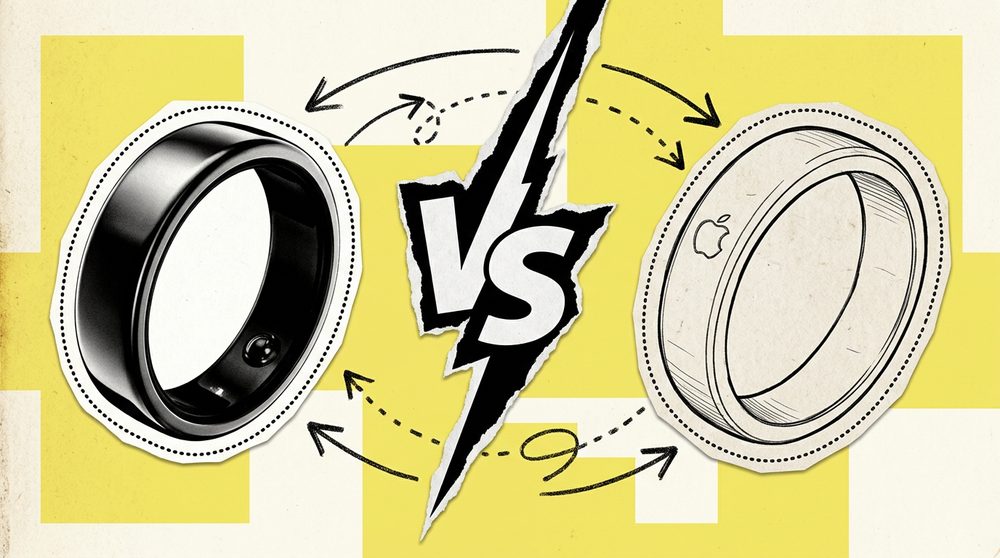
Oura just made its ring 40% smaller and the battery last longer. By any normal product cycle, Ring 5 should be a victory lap. Instead, it's landing the same month multiple reports confirm Apple has an "iRing" in active development — and that timing tells you everything about how fragile the smart ring business actually is.
Oura's model is straightforward: sell the ring for $349 to $549, then charge $5.99 a month for access to the sleep, readiness, and recovery data the ring is already collecting. Without the subscription, the hardware is mostly inert. The ring measures; the subscription interprets. That's the entire business.
Apple has run this exact playbook before — and given it away for free. ECG on Apple Watch. Blood oxygen monitoring. Fall detection. Each one launched as a premium health capability and shipped standard, folded into the Health app at no incremental cost. If Apple brings a smart ring to market and does the same thing with recovery and readiness scoring, Oura's $6/month doesn't just face a competitor. It faces a competitor with no reason to charge for the thing Oura built its business on.
Why this isn't just another hardware launch
The smart ring category has spent four years selling a specific pitch: a screenless, discreet alternative to the smartwatch that tracks sleep and recovery without strapping a screen to your wrist. Oura built that category. Whoop and Ultrahuman validated it from the band side. Garmin and Samsung have circled it without fully committing.
Apple entering changes the category's center of gravity instantly — not because the iRing will necessarily be the best ring, but because Apple controls the distribution. Two billion active devices. The Health app already installed on every iPhone. A subscription bundle (Apple One) that already exists and could absorb ring data the way it absorbed Fitness+. Oura has to win on hardware quality and earn a standalone subscription. Apple just has to ship a ring that's good enough and bundle the data into something people already pay for.
Oura built a $6/month business by being the company that interpreted your sleep data. Apple's whole strategy is making interpretation free and the hardware the upsell.
| Oura | Apple (projected) | |
|---|---|---|
| Hardware cost | $349–$549 | TBD (likely premium) |
| Subscription | $5.99/month required to access data | Likely bundled into Apple One or free via Health app |
| Data interpretation | Paid subscription unlocks readiness, sleep, recovery scoring | Expected to ship standard in the Health app |
| Distribution | Direct purchase; standalone product decision | Two billion active devices; already in pocket |
| Studio member reach | Self-selected minority willing to spend $350+ | Potentially every member with an iPhone |
The scenario that actually matters for studios
Set aside the corporate chess match for a second. The operating question for a fitness studio is simpler: what happens to your member base if recovery and readiness data goes from a $350-plus, $6/month purchase decision to something that ships free on every iPhone?
It gets a lot bigger, a lot faster. Right now, the members walking into your studio with a daily readiness score are a self-selected, performance-obsessed minority — the kind of member who already spent $350 and decided $6 a month was worth it. If Apple makes that same data free and default, every member with an iPhone becomes a potential data-aware member. The pool you can build coaching, programming, and retention conversations around doesn't grow 10% — it could grow by an order of magnitude.
That's the opportunity hiding inside what looks like a hardware story. The wearables war between Apple and Oura is really a fight over who controls the interpretation layer for hundreds of millions of people's sleep and recovery data. interpretation layer: Interpretation layer: the software and algorithms that convert raw sensor data (heart rate, temperature, movement) into actionable scores like readiness or recovery — the part of a wearable business that typically lives behind a subscription paywall. Studios don't need to win that fight or even have a side in it. They need to be ready for the moment it's decided — because whichever way it goes, more members will be walking in with more data than they have today.
What to do before the data shows up
Don't wait for Apple's product announcement to build wearable data into your coaching model. The studios that will benefit most from a sudden expansion in data-aware members are the ones that already have a process for using recovery scores in programming — pulling back intensity on a red day, pushing harder on a green one, building member conversations around trend data instead of just attendance.
If that muscle doesn't exist yet, the smart ring war is the forcing function to build it. Whether Oura holds its ground, Apple eats the category, or both end up coexisting, the direction of travel is the same: more of your members will know more about their own recovery, sleep, and readiness than they did a year ago. The studios that built the coaching layer to use that data will be the ones who convert it into retention. The ones that didn't will just be watching members open another app.
What does Apple entering the smart ring market actually mean for studio revenue?
It means the addressable market for data-aware coaching just expanded dramatically — at no acquisition cost to you. Today, recovery-score members are a niche who self-selected by spending $350-plus. If Apple commoditizes that data inside the iPhone ecosystem, you're not dealing with a minority anymore. You're dealing with your entire member base. The studios that already built programming and retention workflows around readiness data will monetize that shift. The ones waiting to see how the hardware war plays out will watch the opportunity close without ever touching it.