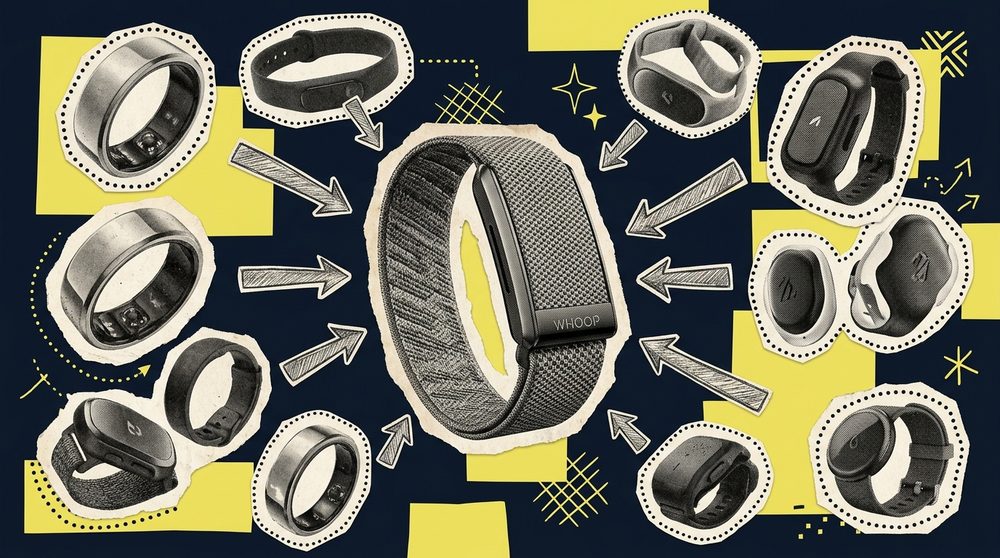
In March 2026, WHOOP raised $575 million at a $10.1 billion valuation. The product: a screenless rubber band. No display. No buttons. No GPS. Just a piece of flexible plastic that sits on your wrist and tells you how recovered you are, how ready you are to train, and how hard you pushed yesterday.
The hardware is free. The subscription — $199 to $359 per year — is the business. And that business is growing at 103% year-over-year with 2.5 million members, more than half of whom are still wearing the device daily 18 months in. WHOOP CEO Will Ahmed has called the recent raise "the last private round we'll do." An IPO is next.
Every major hardware company is paying attention. In May, Google launched the Fitbit Air — a screenless band, no display, direct WHOOP clone, priced at $100. Garmin quietly released the Cirqa. Apple is reportedly in active development on a smart ring. The screenless wearables category that WHOOP built from scratch now has the full attention of the biggest consumer hardware companies in the world.
What WHOOP actually proved
The conventional wisdom in consumer hardware was that people need a screen. They want to see the time, check notifications, glance at their step count. The Apple Watch was built on this assumption. Fitbit's entire early product line was built on it.
WHOOP bet against it. The insight was that a specific type of fitness consumer — performance-obsessed, serious about recovery, not a casual step-counter — didn't want a screen. They wanted data, interpreted for them, delivered as a daily verdict. Sleep performance. Strain score. Recovery percentage. The number that tells you whether to push or pull back today.
WHOOP didn't sell a wearable. It sold a daily answer to the question every serious athlete is asking: am I ready?
— The Run RateRemoving the screen wasn't a compromise — it was the product decision that made WHOOP work. No screen means longer battery life, smaller form factor, and crucially, no competition with the Apple Watch for wrist real estate. Members wear WHOOP in addition to whatever else they're already wearing. The addressable market isn't people who want to replace their watch. It's people who want a second layer of data that their watch isn't giving them.
Why every boardroom is now chasing it
The boardroom interest isn't really about the hardware. It's about the subscription model.
WHOOP cracked something that consumer hardware companies have been trying to solve for a decade: how do you build recurring revenue on top of a physical device? Apple tried with Apple Watch + cellular. Fitbit tried with Fitbit Premium. Most of those efforts plateaued because the value proposition of the subscription wasn't differentiated enough from what the hardware already offered for free.
WHOOP solved this by making the subscription the product. The band is the sensor. The subscription is the intelligence. Members aren't paying $239 a year for the plastic on their wrist — they're paying for the daily personalised verdict, the trend analysis, the coaching recommendations. That's a fundamentally different value proposition, and it has the churn profile to prove it: over 50% of WHOOP members still using daily at 18 months is a retention number most SaaS companies would envy.
Google's Fitbit Air at $100 is an attempt to commoditise the hardware layer and capture the subscription upside. Garmin's Cirqa is the same play from the performance GPS market. Apple's smart ring rumours suggest they want to extend the Health app ecosystem into a new form factor — potentially folding ring data into the existing Apple One bundle at no additional cost, which would reshape the entire category economics overnight.
| Company / Product | Approach | Subscription Cost | Key Strategic Angle |
|---|---|---|---|
| WHOOP (band) | Subscription-first; hardware free with membership | $199–$359/year | Built the category; IPO expected |
| Google Fitbit Air | Hardware at $100; subscription upside | Not yet disclosed | Commoditise hardware, capture recurring revenue |
| Garmin Cirqa | Performance GPS brand extends into screenless recovery | Not yet disclosed | Targets existing performance-athlete base |
| Apple iRing (rumoured) | Data folded into Health app / Apple One bundle | Potentially $0 incremental | Could commoditise subscription model from above |
| Oura Ring | Ring form factor; established recovery tracking | $6/month | Vulnerable if Apple enters at no extra cost |
The wearables war is really a data war. The device is just the collection mechanism. The subscription is where the value lives.
— The Run RateWhat this means for your studio
The screenless wearables boom is not background noise for fitness studio operators. It's a signal about who your most valuable members are becoming — and what they expect from a fitness experience.
Members wearing WHOOP, Oura, or Garmin recovery trackers are already operating on a data-first fitness philosophy. They know their HRV. HRV: HRV (Heart Rate Variability): a measure of the variation in time between consecutive heartbeats, widely used by recovery-focused wearables as a proxy for how well your nervous system has recovered from physical or mental stress. They track their sleep stages. They have a readiness score before they walk through your door. The question is whether your studio's programming and coaching is meeting them where they are — or ignoring a data layer your members are already using to make decisions about how hard to push.
The opportunity isn't to become a wearable retailer or to partner with WHOOP on a discount program. The opportunity is to own the interpretation layer. A coach who looks at a member's WHOOP score and adjusts the session accordingly — pulling back on a low-recovery day, pushing hard on a green day — is offering something no hardware company can replicate at scale. That's the retention hook.
The risk is the inverse. If your studio ignores wearable data entirely while your members are increasingly optimising their training around it, you're creating a mismatch between what they know about their body and what your programming is asking of it. That mismatch is a churn signal dressed up as a retention problem.
The Apple wildcard
The scenario that changes the calculus most dramatically is Apple entering the smart ring category with data folded into the Health app at no incremental cost. Oura currently charges $6 per month on top of the hardware. WHOOP charges $199 to $359 per year. If Apple makes comparable recovery and readiness data freely available to anyone wearing an iRing — the same way they made ECG and blood oxygen available on Apple Watch — the subscription model that WHOOP built gets commoditised from above.
For studio operators, this would actually be a positive development. Cheaper and more accessible wearable data means more members walking in with a data-first mindset. The coaching opportunity gets bigger, not smaller. The studios positioned to capture it are the ones that build wearable integration into their value proposition now — before the member base expecting it is at scale.
WHOOP built a $10 billion category by betting that serious fitness consumers would pay for data interpreted as intelligence. Every major hardware company now agrees. The question for studio operators isn't whether wearables matter — it's whether your coaching, your programming, and your retention conversation are ready for the member who already knows their recovery score before class starts.
What does the screenless wearables boom actually mean for studio retention?
It means the gap between what your members know about their bodies and what your programming asks of them is now measurable — and members will feel it. WHOOP's 50%-plus daily retention at 18 months isn't just a product stat; it's a benchmark for how sticky data-first fitness habits become. Studios that close the loop — coaches who read recovery scores and adjust intensity accordingly — own a retention lever no hardware company can replicate. Studios that ignore it are competing against a personalised daily verdict their members already trust more than a fixed class schedule.