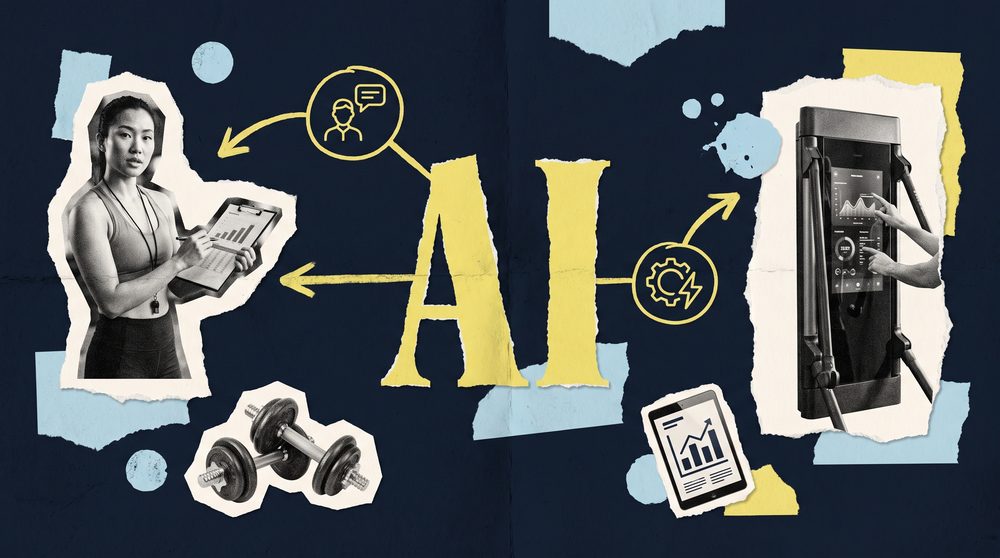
Two of the larger equipment suppliers in fitness are now selling AI programming into commercial gyms rather than just to home users, and it is worth looking at what that actually changes on the floor.
Echelon unveiled its Workout Builder AI at the Health and Fitness Association Show in March 2026. It generates adaptive plans in real time from user performance, goals and feedback, and pairs with the Reflect 60 smart mirror and StrengthIQ machines, pitched explicitly at gyms as well as homes. Separately, EoS Fitness became the first large US gym operator to launch EGYM Genius AI. Echelon has also been building on generative AI with AWS under its Echelon Intelligence work.
None of this is one dramatic launch. It is a supply-side shift that has been arriving in pieces, which is usually how the ones that matter arrive.
Can AI replace a personal trainer's programming?
For the mechanical parts, largely yes. Set and rep schemes, progressive overload, load adjusted from the previous session, warm-ups, cool-downs, and swapping an exercise when the rack is occupied are all pattern problems with well-understood rules, and software handles them reliably. What it cannot do is decide what a member should be training for, notice a hesitation before a heavy set that never reaches the data, or be the specific reason someone shows up on a Tuesday in February.
Separate the job from the artifact
Programming is the design of the training plan itself: exercise selection, volume, intensity, and how those change week to week. It has always been the most visible part of a trainer's work and the easiest to point at when justifying a price. It has also never been the part that produced results on its own.
| Task | Automates well | Does not automate |
|---|---|---|
| Set and rep scheme, progression | Yes | |
| Load adjustment from last session | Yes | |
| Exercise substitution for busy equipment | Yes | |
| Warm-ups and cool-downs | Yes | |
| Deciding the goal the plan serves | No | |
| Technique correction under load | No | |
| Reading pain, fear or reluctance | No | |
| Adherence and accountability | No |
Read the two columns and the commercial consequence is obvious. Everything in the left column used to consume unbillable preparation time. Everything in the right column is what members are actually paying to keep.
The plan was always the artifact. The judgment was always the product.
— The Run RateThe pricing problem this creates
If a comparable plan is available free inside the member app, a personal training package sold as "we write your program" gets harder to defend every quarter. That is not a prediction, it is the same pattern that repriced every category where the deliverable became reproducible.
We made this argument in early August when cheap AI started resetting expectations for what a training plan should cost, and the conclusion holds: gyms have to redefine what personal training is for rather than defend the old description of it. The version that survives is sold on assessment, goal-setting, technique, progression decisions and adherence. None of those are documents, which is precisely why they price.
There is a second-order effect worth planning for. When plan generation is free and instant, the constraint moves to whether the member follows it, and adherence has always been the weakest link in this business. We wrote last month that AI can write your workout plan but it cannot show up for you. A year of watching these tools has not changed that, and if anything the abundance of plans makes the accountability layer scarcer and more valuable.
What to do in the next quarter
Three things, in order. First, look at what your equipment supplier already includes, because a chunk of this capability arrives bundled with hardware you may already own, and paying separately for it would be careless. Second, rewrite your PT packages so the named deliverable is an outcome and a relationship rather than a program document, and price the assessment properly since it is the piece with no software substitute. Third, decide what your trainers do with the hours the software gives back. If the answer is "the same number of sessions with less prep," you have captured the efficiency. If the answer is "more members touched per trainer," you have captured the growth.
The related judgment problem is already on your floor whether you have bought any of this or not. Members arrive with wearable data and ask what to do with it, and we argued this month that readiness scores are usually flagging real overtraining rather than excusing a skipped session. Interpretation is the same skill in a different costume. The machine produces the number and the plan. Somebody still has to decide what it means for this member, this week.