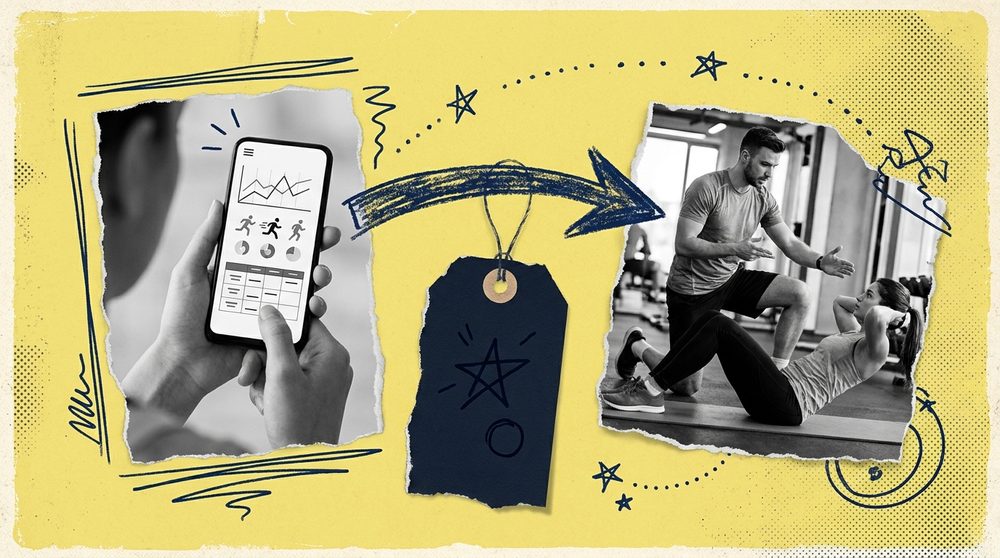
Investors are placing a large bet on the idea that software can do a personal trainer's job for a fraction of the price. Money is pouring into AI coaching apps that write your program, count your reps, and nudge you to train, and the pitch to their backers is blunt. A human trainer costs somewhere between $120 and $350 a month. An app charges $10 to $30. Men's Fitness reports that Wall Street sees a real business in delivering most of the value for a tenth of the cost.
Every headline frames this as a replacement story. The more useful way to read it is as a pricing event. When coaching gets cheap and abundant, what used to be a scarce premium service becomes a default, and the interesting question stops being whether AI replaces trainers. It becomes what a trainer is actually for now.
What does cheap AI coaching actually do to a gym or studio?
It expands the market before it threatens anyone. Most people buying a $15 app were never going to hire a $200 trainer, so the app is not stealing a sale. It is creating a new bottom rung of self-guided exercisers, and that rung feeds gyms over time. People optimize, plateau, and then want the two things software cannot hand them: real options and a room full of other people. The gyms that lose are the ones selling training so generic that an app already does a passable version of it.
Here is the uncomfortable part. AI did not so much commoditize personal training as reveal how little of it was ever differentiated. A trainer who counts reps and emails a spreadsheet is competing head to head with an app that does both instantly, for the price of a coffee. The trainers who are fine are the ones who can say, in one sentence, exactly what they deliver that the app cannot, whether that is return-to-sport rehab, walking a nervous beginner through their first month, or building the community that makes someone show up on a Tuesday they would rather skip.
The data rewards that patience. Digital coaching has a retention problem that in-person coaching does not. Roughly one in three people quit their health apps, and most of the churn (the share of users who stop paying and drop off) lands inside the first month. An app is very good at starting a habit and very bad at rescuing one. That gap is the opening, and it is the same case we made when we argued that AI can write the workout plan but it cannot show up for you.
The DIY member is a segmentation goldmine
For gyms especially, the rise of self-guided training is a data gift. Every member who trains hard but has never booked a session is a signal. They are active, they are engaged, and they have already told you they prefer to self-serve. That is a qualified lead, not a lost cause. Pull the list of members who log frequent visits with zero personal training attached, and you have found the people most likely to buy structured help the moment they hit a wall. Meet them there with a low-commitment on-ramp into semi-private training, a small-group program, or a single form-check session, rather than a hard pitch for a twelve-pack.
Chains that already run their floors on software understand this instinct. When Planet Fitness deployed AI coaches, the point was to give millions of low-touch members a reason to engage and, eventually, a path to pay for more. The same logic scales down to a single independent gym with a spreadsheet of visit data.
What the app owns, and what you own
The line between the two is not price or personalization. It is presence. An app wins on cost and consistency. A gym or a trainer wins on everything that requires being in the room.
| Capability | AI coaching app | The gym or trainer |
|---|---|---|
| Monthly price | $10 to $30 | $120 to $350 |
| Personalized program at scale | Yes | Limited |
| Available at 2am | Yes | No |
| Notices when you disappear | Rarely | Yes |
| A room and a community | No | Yes |
| Reads the person in front of it | No | Yes |
The cheap app is not stealing your best clients. It is training a generation of self-servers who will need you the moment they get serious.
— The Run RateNone of this means the human wins by default. The value has to be named and priced on purpose. The operators who thrive are the ones getting specific, the way the best of them already have. The rise of the longevity coach as the new personal trainer is the same instinct in a different costume, a specialist claim an app cannot make. And the capital is real. Fitness technology keeps attracting serious money, from the funds backing coaching apps to WHOOP's $575 million raise, a sign of how confident investors are that software owns the future of coaching.
They may be right about the software and wrong about the conclusion. Cheap AI does not end personal training. It ends generic personal training, and it hands the operators who were already good at the human parts a bigger, better-qualified pool of people to sell to. The work now is to stop competing with the app on the things it does well, and to charge, clearly, for the things it cannot do at all.