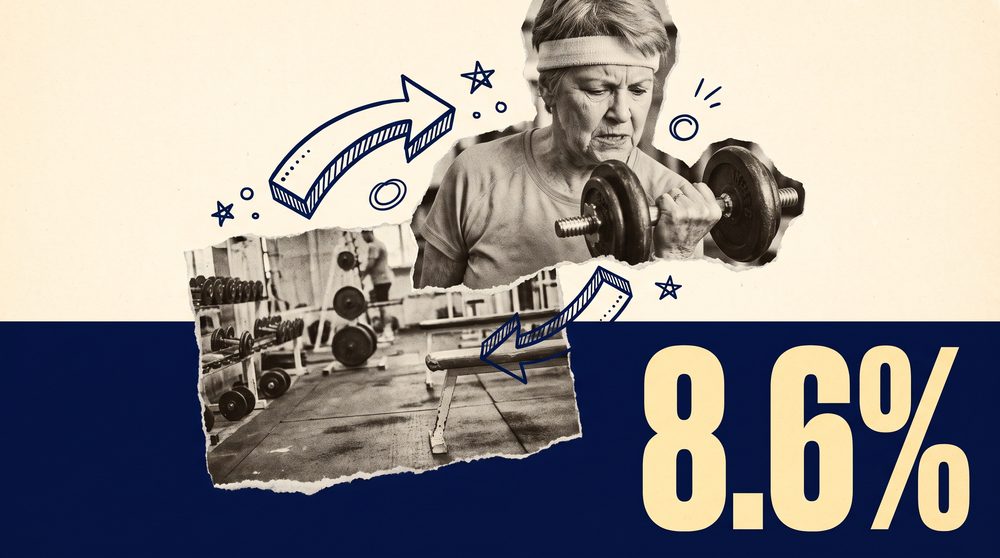
US gym membership hit an all-time high last year. 81 million Americans belonged to a gym, studio or fitness facility in 2025, up 5.2% on the year before.
Under that number is a split worth knowing about.
The fastest-growing group is the oldest one
The Health & Fitness Association's 2026 consumer report found members aged 65 and over grew 8.6% year on year. That is the fastest of any age group, and well ahead of the 5.2% across all members.
Meanwhile adults aged 18 to 24 still have the highest membership penetration of any group, at 35.5%.
Read those two facts together and the marketing instinct makes sense but points the wrong way. The young segment is the one you already have. It is the most saturated part of the market. The growth is arriving at the other end of the age range, and most gym marketing still shows a 25-year-old.
| Group | What the data says | What it means for you |
|---|---|---|
| 18 to 24 | Highest penetration, 35.5% | Saturated. Expensive to win another one |
| 65 and over | Fastest growth, 8.6% | Arriving on their own. Mostly unmarketed to |
| All members | 81 million, up 5.2% | An all-time high, unevenly distributed |
Why is the over-65 member growing fastest?
Because the reason to train changed. This group is buying the ability to keep doing things: carrying shopping, getting off the floor, travelling without worrying. The industry has a term for it now, healthspan, meaning the years you stay capable rather than simply alive. That idea went mainstream as strength and longevity moved into ordinary conversation. We saw the same shift when VO2 max turned into a consumer product. The demand is not new. What is new is that people have a name for what they want.
The money is already being spent, just not with you
Separate research this week puts a number on that demand, though it is worth being precise about what it measured.
Boston Consulting Group, working for the St Moritz Longevity Forum, surveyed 10,608 people across 12 countries. It found women in perimenopause and menopause spend a median of $84 a month on longevity products and services, against $68 for other women and $73 for men. They try more things too, adopting interventions at rates 15 to 22 percentage points higher than other groups.
And they are not satisfied. Satisfaction sits around 50%, no better than anyone else's. About a third said they would spend $108 a month if the products actually worked. BCG puts the unmet demand at $350 billion.
One caveat we should state plainly, because it matters. BCG measured longevity products and services, not gyms. There is no fitness or gym figure anywhere in that report. Putting it next to the membership data is our connection, not theirs. What the two together suggest is a group that is already spending, already dissatisfied, and already walking through your door.
They are already spending. They are already unsatisfied. They are already in your building.
BCG's Parul Bajaj made the timing point better than we could: “Companies wait for menopause before they start talking to women about long-term health, but the real window opens about a decade earlier.”
What to change, in order
Start with the pictures. Look at the last twenty images you posted. If nobody in them is over 50, you have quietly told the fastest-growing group in the market that your gym is not for them. That check costs you nothing.
Then the schedule. This member can train at 10am. That is the capacity you already pay rent on and cannot sell to anyone with a job. Treat the quiet hours as a feature you are selling rather than a gap you are discounting, the same argument we made about dead inventory in the schedule.
Then the staff. Somebody on your floor needs to be comfortable programming for a 62-year-old with a replaced knee. If nobody is, that is a training decision, and it is cheaper than an acquisition campaign.
Last, the label. Resist calling it a seniors class. Segment by what someone can do, not when they were born, so the same programming works for a 52-year-old and a 70-year-old. We made a version of this argument about rucking as a strength on-ramp for women: the on-ramp works when it meets people where they are and does not announce that they are a category.
The marketing is pointed at the group with the least room left in it. Turn it around.