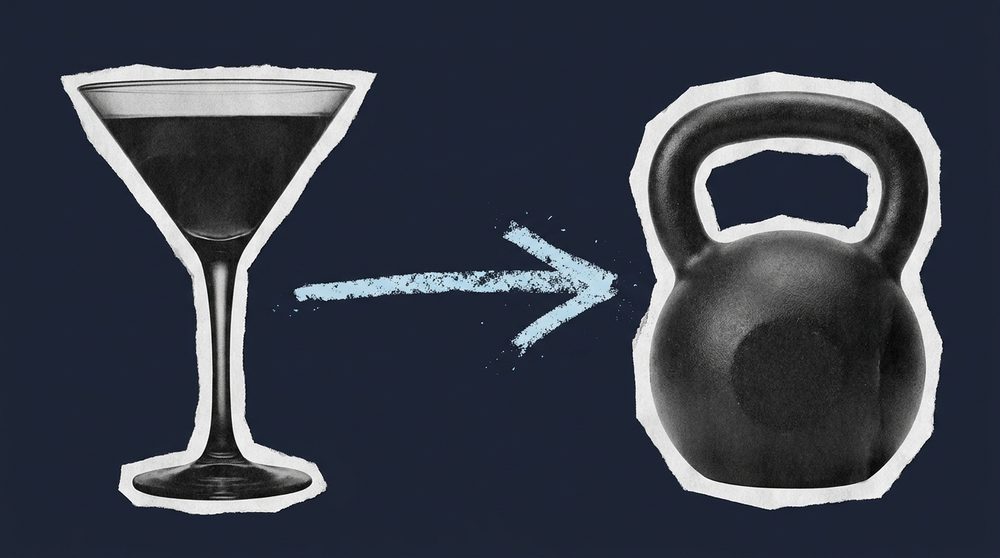
US drinking just hit its lowest rate since Gallup started tracking it in 1939. Only 54% of Americans now report drinking alcohol at all. At the same time, Gen Z credit and debit card spending on fitness grew 9% according to Bank of America Institute — while spending at bars grew less than 4%.
The easy read is "Gen Z quit drinking." The more useful read is that Gen Z reallocated its discretionary spend (the income left after essentials — the same pool bars, studios, and travel all compete for) and its social calendar toward whatever currently signals status and belonging — and right now, that's health, wellness, and shared experience, not what's in your glass.
This is not a temperance movement. It's a reprioritization. Bank of America frames it as "moving from barstools to barbells," and the framing matters: this is about where a generation chooses to spend its evenings and its identity, not a moral stance on alcohol. Sixty-four percent of Gen Z now report drinking primarily at home, up sharply from the year before, and bar/club consumption specifically has dropped from 45% to 23%. The social ritual didn't disappear. It moved.
This isn't a temperance movement. It's a reallocation — of money, of evenings, of what counts as a good story to tell your friends.
— The Run RateAmericans overall are planning to spend $60 billion on fitness in 2026, according to the Health & Fitness Association — and Gen Z is disproportionately driving that number. That's not a niche behavioral quirk. That's a generation's entire discretionary spending pattern shifting, and studios that treat this as a wellness trend rather than an acquisition opportunity are going to watch competitors capture it first.
| Metric | Number | Source |
|---|---|---|
| US adults who drink alcohol | 54% — lowest since tracking began in 1939 | Gallup, 2025 |
| Gen Z card spend on fitness | +9% YoY | Bank of America Institute |
| Gen Z card spend at bars | Under +4% YoY | Bank of America Institute |
| Gen Z drinking primarily at home | 64%, up sharply year over year | Bank of America Institute |
| Bar/club share of drinking occasions | 45% → 23% | Bank of America Institute |
| Planned US fitness spend, 2026 | $60 billion | Health & Fitness Association |
What does this mean for boutique studio acquisition strategy?
It means the pitch to Gen Z can't just be "get fit." It has to be "this is where you go instead of the bar" — the social occasion, the group chat, the thing you post about. Studios already seeing this shift are winning on programming built around shared identity and group progress, not solo weight-loss goals.
This connects directly to the format shift already underway. "The vibe era is over" in boutique fitness — but the social era isn't. Gen Z still wants the room, the group, the shared effort. What they don't want anymore is a vague "vibe" without a clear reason to show up sober and early. Studios that pair real programming rigor with genuine social occasion — a Friday night class that functions as the new happy hour, a community leaderboard that replaces the group chat about weekend plans — are the ones actually capturing this dollar.
The acquisition math backs this up too. 80% of new members already come from just three sources, and referral-driven, community-first studios consistently outperform paid acquisition for exactly this cohort — Gen Z trusts a friend's Instagram story about a 6am class far more than an ad. If your studio's Gen Z acquisition strategy is still a discount code and a Google ad, you're fighting for a customer who is choosing where to spend based on social currency, not price.
There's a positioning trap worth naming directly: don't market to Gen Z as "the sober generation." That's not how they see themselves, and it's not accurate — the Bank of America data shows this is about reallocation of spend and social time, not a moral stance on drinking. The winning message is aspirational, not corrective: this is where the interesting people are going, this is what's worth telling your friends about, this is the thing happening on a Tuesday night instead of nothing. Studios that lead with judgment about what Gen Z used to do lose. Studios that lead with what Gen Z gets to do now win.
The generation isn't disengaging from social life. It's rebuilding it around a different center of gravity — and for the first time in a long time, that center of gravity is a fitness studio instead of a bar. That's not a wellness footnote. That's the acquisition opportunity of the next two years, and it belongs to whichever studios treat Gen Z's Tuesday night the way a bar used to.