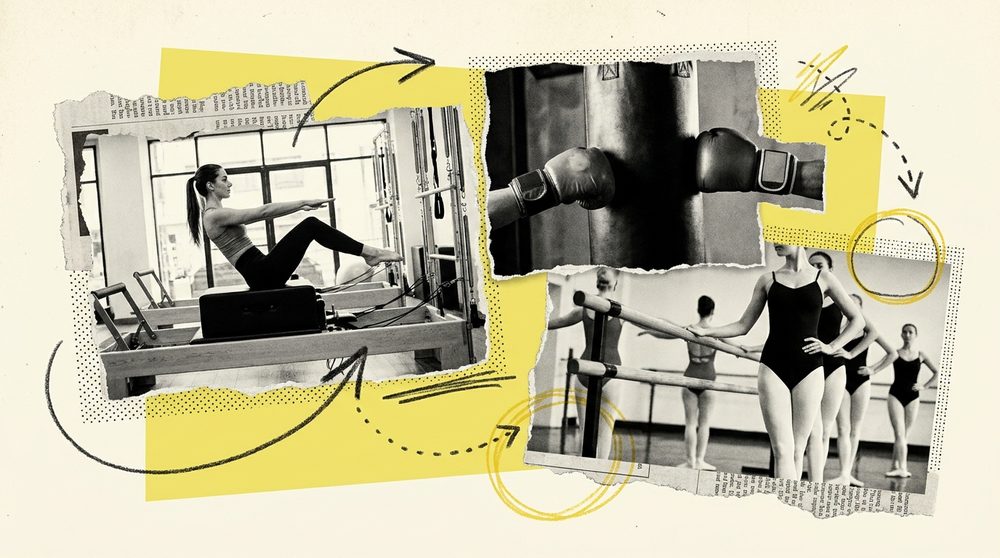
Boutique fitness had a beautiful run. Pilates studios opened on every block. Boxing gyms sold out memberships in pre-launch. Barre classes filled the 6am slot every morning. The format was the product. The lighting, the music, the energy, the instructor's name — these were the differentiators. Getting in the door was enough.
The era is ending. Not because the formats are broken, but because the members have changed. They're older. They're better-informed about what exercise actually does. They're tracking their health more closely than any previous generation. And they're starting to ask a question the vibe economy never had to answer: am I actually getting results?
The studios built on atmosphere alone are feeling this. The ones built on outcomes are growing through it.
What built format fitness
The boutique fitness boom from roughly 2008 to 2022 was driven by a specific consumer psychology: fitness as identity. Going to SoulCycle said something about you. Having a reformer Pilates membership placed you in a social category. The format wasn't just exercise — it was a tribe, a lifestyle signal, a community.
This worked because the core customer was 25-35, highly social, Instagram-active, and buying a feeling as much as a fitness outcome. The energy of the class, the quality of the playlist, the personality of the instructor — these were legitimate product features. And they were genuinely hard to replicate at Planet Fitness for $10 a month.
But that customer is now 35-45. Her priorities shifted. The Instagram aesthetic matters less. The results matter more. She has a VO2 max number now. She knows what her resting heart rate is. Her Apple Watch told her she had a possible cycle deviation and suggested she talk to her doctor. She's done the research. She's reading the longevity studies.
She still wants community. She still values great instruction. But she needs those things to come with a credible answer to the question her old studio couldn't answer: what is this actually doing for my body?
The results gap
The format fitness industry has a measurement problem. Most studios don't track member outcomes in any systematic way. They track attendance. They track revenue per member. They run NPS surveys about the experience. But they have almost no data on whether their members are getting stronger, improving cardiovascular fitness, losing body fat, or achieving any of the health outcomes that motivated the membership in the first place.
This was invisible when vibes were enough. It's now a structural vulnerability.
"The format was the product. That worked when the member was buying an identity. It stops working when she's buying an outcome."
— The Run RateMembers who don't see measurable progress churn. Not immediately — the community keeps them longer than a bad product would — but eventually. The 63% of departing format fitness members who cite "not seeing results" as a reason aren't leaving because they disliked the class. They're leaving because the class and the results became disconnected, and when that happened, the price-to-value math stopped working.
The studios that retained them longest were the ones that could point to something — a progress metric, a visible change, a coach who named what was improving and why.
What results-first programming actually looks like
Results-first doesn't mean abandoning the format. It means engineering the format to deliver measurable outcomes and then making those outcomes visible to the member.
This starts with programming design. The evidence on what actually produces results — strength gains, cardiovascular improvement, body composition changes — is clear. Progressive overload in resistance training. Progressive overload: Progressive overload: the principle of gradually increasing the stress placed on the body during training — through heavier loads, more reps, or reduced rest — so that muscles and cardiovascular systems are continually forced to adapt and improve. Zone 2 cardio volume. Adequate recovery. Protein intake. Sleep. Stress management. The formats that deliver these things are the formats that produce results. The formats that don't are the ones running their members through the same experience week after week and calling it a workout.
Pilates is a useful case study. Classical reformer Pilates builds tremendous core stability, flexibility, and body awareness — genuine, evidence-backed outcomes. But a 50-minute reformer class at moderate resistance, taken twice a week, will not build meaningful muscular strength for most adults. Studios that recognize this are adding periodized strength progressions, heavier spring loads, and deliberate overload phases. The ones that don't are giving their members an exceptional movement experience that, over time, doesn't change their body.
| Format | Genuine outcomes delivered | Structural gap |
|---|---|---|
| Reformer Pilates | Core stability, flexibility, body awareness | Insufficient load for meaningful muscular strength gains |
| Boxing | Aerobic fitness, calorie burn, coordination, reaction time | Almost no posterior chain or lower body strength work; limited progressive overload |
| Barre | Muscular endurance, posture, hip stability | Loads too light to produce strength adaptations or build lean muscle mass |
Boxing formats have a different problem. The cardiovascular intensity is genuinely high — excellent for aerobic fitness, significant calorie burn, real improvements in coordination and reaction time. But pure boxing programming has a structural gap: almost no posterior chain training, minimal lower body strength work, and limited progressive overload. Members whose primary goal is body composition improvement will plateau inside six months.
Barre's challenge is the opposite of boxing. The stability work, the isometric holds, the small-range movements — these build real endurance in specific muscle groups. But the loads are almost universally too light to produce strength adaptations. A member who does barre four times a week for two years may have excellent posture and better hip stability. She will not have built meaningful lean muscle mass.
Hybrid programming as the answer
The studios growing fastest right now share a common structural pattern: they have a format identity but a hybrid programming architecture underneath it.
This means strength and cardiovascular training as a non-negotiable foundation — not an add-on, not a specialty track, but the baseline requirement for any programming that claims to produce fitness results. A Pilates studio that adds structured barbell or cable resistance work isn't diluting Pilates. It's building a complete program that keeps its members progressing past the plateau every single-modality studio hits.
The best version of this looks like a periodized 12-week block where the format sessions (reformer, boxing rounds, barre sequences) serve a specific physiological purpose within a broader adaptation cycle — rather than being 50 independent, interchangeable classes with no cumulative design.
Members who experience this kind of programming describe it differently than members in format studios. They don't just say the class was great. They say they got stronger. They ran faster. Their back stopped hurting. They can see the difference. Those outcomes are what retention is actually made of.
The consolidation signal
The VC-backed rollup plays targeting boutique fitness studios in the past three years are reading the same market signal. The acquisition targets aren't the highest-vibe studios. They're the ones with strong unit economics, scalable operations, and — increasingly — programming that can be systematized and replicated without degrading member outcomes.
Studios built entirely on the personality of a single founding instructor or the feel of a flagship location are expensive to acquire and hard to scale. Studios with a defined programming system — where results are reproducible across locations and coaches — are the ones that look like assets rather than liabilities under due diligence.
If you're building a studio to own for 10 years, or building it to sell, the same thing is true: the programming needs to produce results that can be documented, communicated, and replicated.
What the winners look like
The format fitness studios positioned to lead the next decade share a few characteristics that have nothing to do with how good their playlists are.
They track member progress. Not NPS — actual fitness metrics. Weight on the reformer. Heart rate zones. Movement assessments. Benchmarks at onboarding and every 90 days after. They can show a member what changed, not just tell her she's doing great.
Their coaches can prescribe. Not just lead. A coach who can assess a member's current fitness level and recommend a progression — more spring resistance, heavier gloves, a more challenging barre variation — is delivering a fundamentally different product than one who cues the same class for every body in the room.
Their programming connects. Each class exists in the context of a larger adaptation cycle, not as a standalone 50-minute experience. Members who understand where they are in the cycle — what they're building this month, why the format is changing next month — have a completely different relationship with the studio than ones who just show up and sweat.
And critically: they can articulate results. In their marketing. In their sales conversations. In the language coaches use on the floor. "You're getting stronger" is not the same as "Great job today." One is a promise that creates retention. The other is a pleasantry that creates churn.
The vibe was never the enemy. It was always an asset — community, atmosphere, energy are genuinely differentiating in a way that a globo-gym never can be. But the vibe alone was only ever a first-generation product. The studios that understood this early are building second-generation businesses. The ones that didn't are about to find out.
What does a results-first studio actually have to change?
More than the programming sheet. Results-first studios are rebuilding the member relationship around measurable progress — tracking strength baselines, naming cardiovascular improvements, giving coaches language to explain what's adapting and why. The format stays. The identity stays. What changes is the accountability infrastructure underneath it. Members who see a number move — a heavier spring load, a lower resting heart rate, a documented strength gain — renew. Members who only remember the playlist eventually do the math and leave. The studios winning right now made that accountability a core product feature before they lost the members who demanded it.