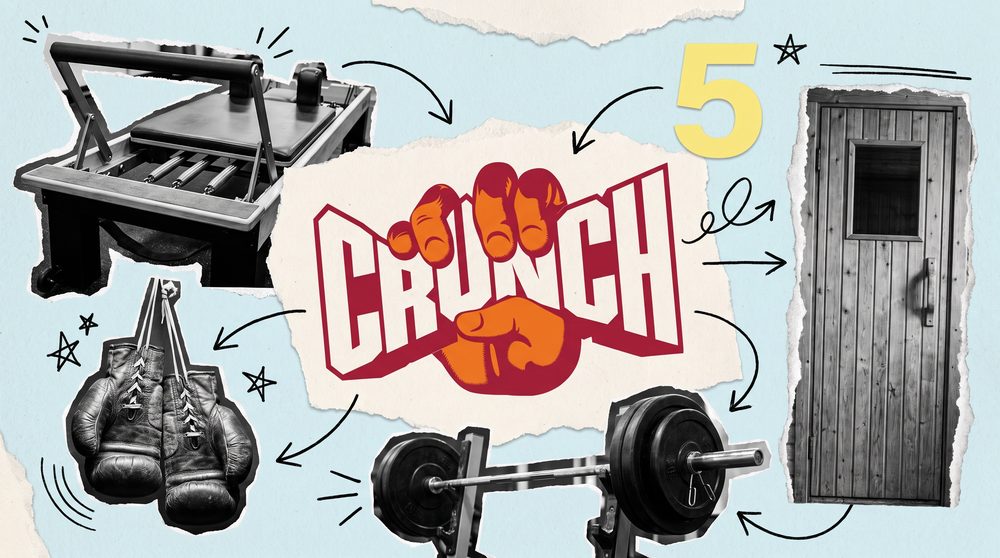
In August, Crunch Fitness announced the next evolution of Crunch 3.0, its club blueprint. The list is longer than the usual refresh. Crunch Reform Pilates. A Pump strength training studio. An Abs and Glutes studio. A Spar boxing studio. An expanded Relax and Recover suite carrying infrared sauna, red light therapy and hot-cold contrast therapy.
Alongside it, the premium banner Crunch Select relaunches as an amenity-rich multi-boutique club, with the first revamped location opening in Long Beach, New York later this year, featuring dedicated studios for HIIT, hot yoga, mat Pilates and strength, plus a contrast therapy suite and a barbell room.
All of it sits inside the membership.
What is Crunch Select?
Crunch Select is Crunch Fitness's premium banner, relaunching as an amenity-rich multi-boutique club under the wider Crunch 3.0 blueprint. Rather than a single gym floor with a class schedule attached, a Select club carries dedicated studios for separate modalities, HIIT, hot yoga, mat Pilates and strength, alongside a contrast therapy suite and a barbell room. The first revamped location opens in Long Beach, New York later this year. The defining feature is that access to all of it is bundled into the membership rather than sold as add-ons.
Does a budget gym adding boutique studios actually threaten a premium studio?
Not in the way the headline implies. A bundled Pilates class on a big-box floor and a session at a specialist studio are different products, separated by instructor quality, class size, equipment and the people in the room. Very few members switch on the basis of the bundle alone. The threat is indirect, and it is about pricing: a prospect now arrives at your consultation carrying a new belief about what these modalities cost, and your rate has to answer for the difference in a way it did not have to last month.
What price anchoring does in a consultation
Price anchoring (the reference point a buyer unconsciously measures every other price against) is the mechanism worth understanding here, because it operates before anybody says a word about value.
Until recently, a prospect weighing a boutique membership held two mental categories that did not overlap. Budget gyms were equipment and space. Boutique was instruction and format. The prices were not really compared because the products were not really comparable, and a studio could hold a premium without explaining it.
When five boutique modalities appear inside a budget membership, those categories collapse into one. The prospect does not conclude that your studio is overpriced. They conclude that they now have a comparison to make, and they will make it silently, during the tour, while your staff talks about community.
| What the bundle includes | What it does not include |
|---|---|
| Access to the modality | Instructor with hundreds of hours in that modality |
| Equipment on the floor | Class size small enough for correction |
| A class on the schedule | Programming that progresses across weeks |
| A recovery room | The cohort that notices when you stop coming |
Every line in the right-hand column is real and defensible. The problem is that none of it is visible on a price page, and a prospect comparing two numbers cannot see any of it unless somebody says it out loud.
The market is not actually telling you to drop your price
Worth holding onto, because the panic response here is a discount. Boutique studios account for roughly 42% of total US fitness industry revenue while representing about 25% of memberships, which is a direct measurement of pricing power rather than a projection. Average class prices rose about 6% year over year, from $20.10 to $21.32, and attendance is at or near pre-pandemic levels.
People are paying more for boutique fitness, not less. What is changing is that the premium now requires an argument.
We made a version of this case when we wrote that Equinox does not compete on price but on identity, and the same logic scales down. A studio at $200 a month and a gym at $30 a month are not in a price war unless the studio agrees to be in one.
What to actually do
Name the difference first, and name it in specifics. Not "expert instructors" but the actual training hours. Not "small classes" but the cap. Not "premium equipment" but the brand and the count. Adjectives read as marketing. Numbers read as evidence, and they survive the comparison the prospect is making in their head.
Then check where your own price actually sits. This is the third Crunch move we have covered this year, after its earlier bet on Pilates and the franchisee buyback that preceded the 3.0 rollout, and the direction has been consistent all year. Low-cost operators are pivoting from price-led positioning to experience-led value, which means the floor keeps rising. Our framework for pricing a boutique studio without racing to the bottom is the place to start if you have not revisited your rate since spring.
And if the answer turns out to be that you cannot raise the price, the lever moves to what each member is worth instead. We went deep on that in this month's Take on growing revenue in double digits on single-digit member growth, which lays out four ways to raise revenue per member when adding members is the hard part.
Crunch has not built a boutique studio. It has built a very good argument that boutique modalities are worth about thirty dollars a month, and it is going to make that argument to your next prospect before you get to. The response is not a lower price. It is a better sentence.