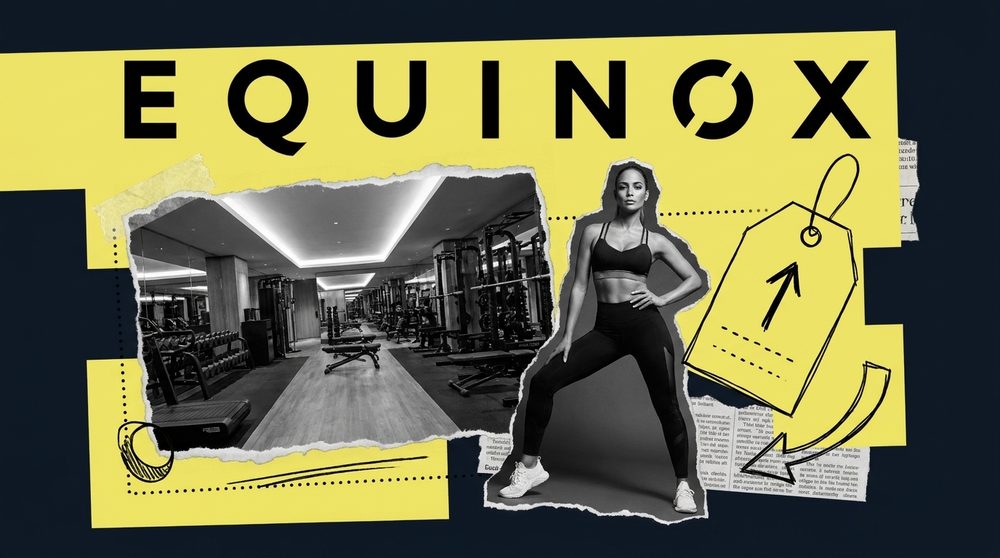
The Wall Street Journal ran a piece recently on how Equinox has held its pricing at a level most fitness operators consider impossible: north of $300/month in most markets, $4,000+ annually. The story framed it as a luxury story. That's the wrong frame.
Equinox isn't expensive because of the towels. It's expensive because it built a habit loop that makes cancellation feel like a demotion.
What's actually happening
The Equinox model has three interlocking parts that most boutique studios never build simultaneously — and all three have to work together for the pricing to hold.
Part one: an identity claim sharp enough to mean something. "It's not fitness. It's life" isn't a tagline. It's a positioning statement that implies everyone who doesn't train at Equinox is, at some level, settling. That's a bold thing to put in a campaign. It's also why their members don't comparison shop on price. They're not paying for a gym. They're paying to be someone who trains at Equinox.
Part two: a physical environment that reinforces the identity daily. The facilities are exceptional, but that's almost beside the point. The real work the environment does is signal back to the member that they made the right choice. Every time you walk into an Equinox, the space tells you something about who you are. That's not interior design — it's retention infrastructure. Members who feel that signal are dramatically harder to cancel than members who just evaluate the equipment.
Part three: the habit loop. Equinox proprietary programming — The Pursuit, Precision Running, their instructor training protocols — creates experiences you can't get elsewhere. That specificity is intentional. Once your routine is built around a class format that only exists inside Equinox, leaving means disrupting your routine, not just your membership. The switching cost is behavioral, not financial. Behavioral switching cost: Behavioral switching cost: the friction a member experiences when leaving is rooted in disrupting an ingrained routine or identity, rather than in financial penalties like cancellation fees. And behavioral switching costs hold far better than financial ones.
Why this matters for your studio
Most boutiques try to raise prices by adding a service. A sauna. Better app. Expanded hours. Then they raise prices 10% and wait. It doesn't hold because they've addressed the product without addressing the identity.
Price tolerance is emotional before it's rational. A member who believes your studio exists to help them become a specific version of themselves — stronger, faster, part of something with a name and a reputation — will pay more and stay longer. A member who sees your studio as a workout option among several will churn the moment a competitor opens nearby or ClassPass gets cheaper.
The gap isn't amenities. It's conviction.
Price tolerance is emotional before it's rational. The gap isn't amenities — it's conviction.
The playbook, specifically
1. Say who you're for — and who you're not for. Define your member explicitly. The more specific the claim, the more magnetic it is for the right person — and the more it filters out the wrong ones. A brand that speaks to everyone holds pricing power over no one.
2. Build at least one proprietary experience. A class format, a training methodology, a results protocol — something that only exists inside your studio, that members build their routine around. Lagree did this with a reformer variation and a name. You don't need new equipment. You need a named method.
3. Let the environment say something. This doesn't require a renovation. It requires intention. What does a member feel the moment they walk in? What does that environment tell them about who they are? If the answer is "nothing specific," that's the gap.
4. Price after you have the identity, not before. If you're raising prices to cover costs, you're playing defense. If you're raising prices because your brand now commands genuine belief, you're playing offense. These are different businesses with different ceilings.
| Defensive Pricing | Offensive Pricing |
|---|---|
| Triggered by rising costs | Triggered by earned brand conviction |
| Justifies price with amenities (sauna, hours, app) | Commands price through identity and positioning |
| Members comparison-shop on value | Members don't comparison-shop — they're paying to be someone |
| Price increases don't hold | Price increases hold because switching feels like a demotion |
| Solves a product problem | Solves a positioning problem |
What to watch
As budget chains add AI coaches and close the product gap, the identity gap between tiers widens for boutiques that haven't staked a claim. In three years, the studios holding pricing power will be identity anchors with a name, a POV, and a habit loop. The ones that aren't will be competing on price with operations that have far more scale.
Equinox isn't selling fitness. It never was. The sooner boutique operators internalize that, the sooner they stop trying to justify their price with amenities and start building the thing that actually holds it.
Why can't most boutique studios hold a price increase?
Because they're solving the wrong problem. Adding a sauna or extending hours addresses the product — it doesn't address belief. Members churn when they see your studio as a commodity, and no amenity upgrade changes that calculus. The studios holding pricing power in three years won't be the ones with the best equipment. They'll be the ones whose members feel a genuine identity cost when they consider leaving. That's not a marketing problem. It's a positioning problem — and it has to be solved before the price increase, not after.
Sources
- Wall Street Journal — Equinox pricing and brand strategy, 2026
- Equinox brand campaign: "It's not fitness. It's life."
- IHRSA Global Report — boutique fitness pricing premium vs. traditional gym