In June we argued that the longevity clinic was coming for your most valuable members. The pitch was simple. As health optimization becomes infrastructure, boutique studios either plug into it or get bypassed by the clinics that sell members an outcome and a data story the gym never learned to tell. At the time it read as a premium-tier problem, something that threatened the studios charging $300 a month in affluent zip codes.
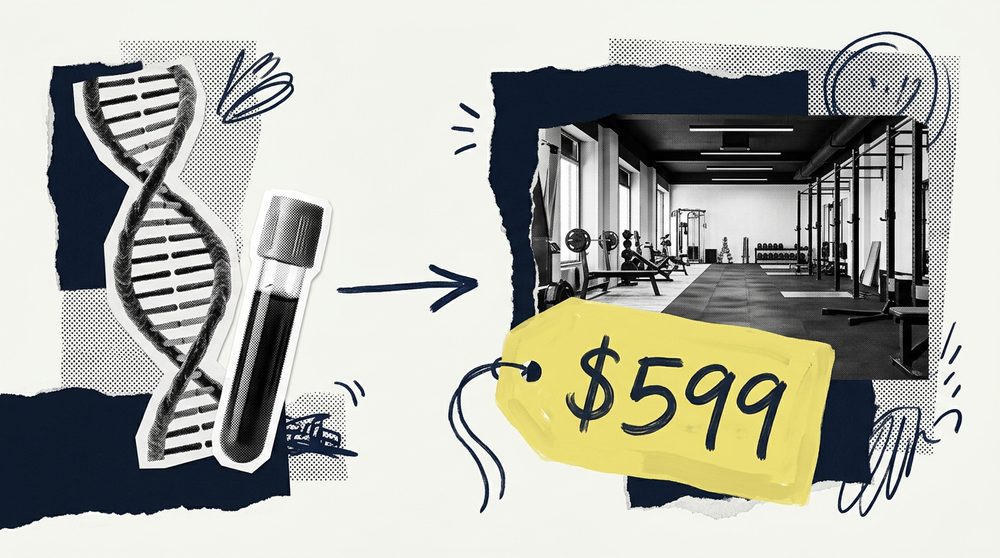
That framing has a shelf life, and it just got shorter. On August 3, Human Longevity announced clinical-grade whole-genome sequencing for $599, a service it markets as Genomics for All. Not a consumer ancestry kit. The full genome, all 6.4 billion base pairs, sequenced at 30x depth, with results interpreted by AI and delivered through an app. No clinic visit required.
The number is the story. Clinical genome sequencing used to cost thousands of dollars and sit behind a concierge membership. At $599 it moves into the price band of a decent wearable or a few months of a studio membership. When a category-defining service drops to impulse-purchase territory, it stops being a luxury and starts becoming an expectation.
What does $599 genome sequencing mean for fitness studios?
It means the longevity upsell is going mass-market, and the window to enter it on your own terms is closing. When only the wealthy could afford genomic and diagnostic services, a studio could ignore them and lose only a sliver of high-end members. Once those services cost less than a smart ring, ordinary members start expecting their gym to have a point of view on them. The operators who move now can build referral and testing partnerships as a premium add-on. The ones who wait will be answering member questions about data they have no way to interpret, while a clinic down the street quietly becomes the trusted source.
It helps to be precise about what $599 now buys, because the gap between a novelty and a medical service is the whole point.
| Consumer ancestry kit | Clinical whole-genome sequencing |
|---|---|
| Reads under 0.02% of the genome | Sequences all 6.4 billion base pairs |
| SNP-chip sampling | 30x depth, the clinical interpretation standard |
| Ancestry and trait novelties | Flags 10,000+ inherited disease-risk variants |
| Not medically actionable | Includes pharmacogenomic markers that affect medication response |
Whole-genome sequencing (reading a person's entire DNA rather than a sample of common markers) is what separates this from the spit-in-a-tube kits members already distrust. This is medical-grade data at a consumer price. Pair it with the fact that the FDA just cleared the way for compounded peptide therapies, and the longevity menu that lived inside $500-a-month clinics a year ago is being unbundled and repriced for everyone.
When a category-defining service drops to impulse-purchase territory, it stops being a luxury and starts becoming an expectation.
— The Run RateHow should operators respond?
The instinct to sell this yourself is the wrong one, and it is worth being clear about why. Members do not trust a gym to interpret their genome, and they should not. What members do trust their gym for is the training that acts on the data. That is your lane, and it is a good one. The clinic can tell a member their genetics favor a certain training response or flag a cardiovascular risk. You are the one who turns that into a program they follow three times a week.
So partner into the stack rather than trying to own it. Three shapes work, in rising order of commitment. The lightest is a referral relationship with a local longevity or diagnostics provider, where you send members out and receive their high-level results back with consent, then build programming around them. The middle option is on-site testing days, where a partner runs VO2 max, bloodwork, or body composition in your space on a recurring schedule. The deepest is a co-located or in-house diagnostics offer for the operators with the capital and the membership base to support it. We covered the softer version of this shift when we noted that the longevity coach is becoming the new personal trainer. The $599 genome just moved up the timeline.
The through-line is trust. As we wrote when trust in doctors fell to 40 percent, the operators who win the longevity conversation are the ones members already believe. A gym that helps a member act on their data honestly, and refers out the parts it has no business interpreting, earns that trust. A gym that ignores the data entirely cedes its most engaged members to whoever will have the conversation instead. In June the clinic was coming for your members. Now it is coming at $599, and the only real question is whether you are in the room when it arrives.