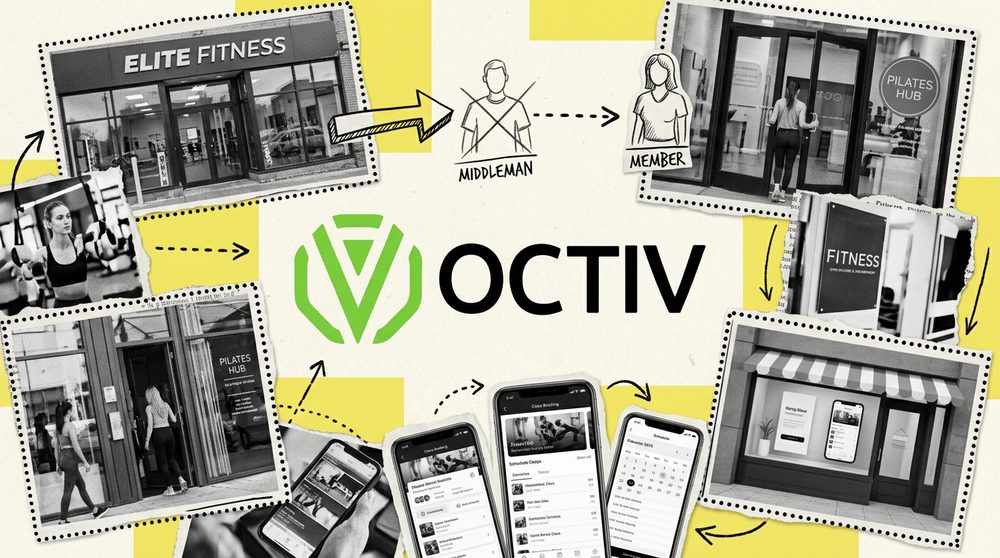
For the last decade, boutique fitness studios have been quietly paying a tax. Not to the government — to aggregators. ClassPass, Mindbody Marketplace, and their competitors built the distribution layer that studios relied on for discovery and new member acquisition. In exchange, they took the margin, owned the customer relationship, and trained members to hunt for the cheapest drop-in rate. It was a deal that made sense when you had no other option. That window is closing.
Octiv, the gym management platform operating across 1,400 facilities in more than 40 countries, just launched Octiv Explore — a consumer-facing discovery engine embedded directly into its platform. Every gym on Octiv now gets a public storefront page: searchable, bookable, and connected straight to the studio's own schedule. No commission. No third-party cut. No algorithmic landlord deciding whether your Tuesday HIIT class shows up in the feed.
The Shopify Playbook, Applied to Fitness
If this move feels familiar, it should. Shopify spent years building back-end commerce infrastructure for independent retailers — then launched Shop, a consumer-facing discovery app that let those same merchants acquire customers without paying Amazon's toll. The operational software became the acquisition channel. Merchants who understood the shift early built brand equity and customer data they actually owned. The ones who stayed dependent on marketplace traffic found themselves increasingly commoditized.
Octiv is running the same play. The insight is identical: you already have the operator relationships, the scheduling data, the class inventory. Why route a prospective member through a third party when the infrastructure to connect them directly already exists in the platform they pay for every month?
The studios that win next won't be the ones with the best product. They'll be the ones that stopped renting their audience and started owning it.
— The Run RateFor studio owners, the tactical implication is immediate. A public storefront page indexed by search engines means your studio can appear in organic results for local fitness queries — without paying ClassPass to be visible. A direct booking flow means first-party data on every person who converts: their name, their preferences, their behavior. first-party data: First-party data: information collected directly from your own customers through your own channels — bookings, purchase history, communication preferences — as opposed to data licensed or inferred through a third-party platform. That data compound interest is what separates a studio with pricing power from one that's perpetually discounting to fill off-peak slots.
What Aggregators Actually Sold You
To be precise about the problem: aggregators weren't selling you customers. They were renting you access to their audience — an audience they built, brand relationships they own, and search rankings they control. The moment you stop paying, the traffic stops. Every booking made through a third-party marketplace is a transaction that happens outside your CRM, outside your retention funnel, and outside your ability to follow up with a membership conversion offer.
The studios most exposed to this dynamic are the ones that leaned hardest into ClassPass to fill capacity during slower growth periods. It works — until your yield-per-member tanks, your front desk staff spend half their day managing drop-in logistics, and you realize that 30% of your floor is occupied by people who will never pay your rack rate. The aggregator filled seats. It didn't build your business.
| Aggregator Channel (e.g. ClassPass) | Owned Channel (e.g. Octiv Explore / direct) |
|---|---|
| Customer relationship owned by the aggregator | Customer relationship owned by the studio |
| Booking data sits outside your CRM | Every booking feeds your CRM and retention funnel |
| Traffic stops when you stop paying | Organic search visibility compounds over time |
| Commission or margin cut on every transaction | No per-booking fee beyond platform subscription |
| Members price-anchored to discounted drop-in rates | Members acquired at or near rack rate |
| No ability to follow up with membership conversion offers | Full ability to nurture toward membership |
Every booking made through a third-party marketplace is a transaction that happens outside your CRM, outside your retention funnel, and outside your ability to convert.
— The Run RateThe Infrastructure Shift You Should Be Watching
What Octiv has done — and what other platforms will follow — is reframe the gym management stack as a complete go-to-market system, not just operational plumbing. Scheduling, payments, member management, and now discovery and acquisition: all inside one platform, all generating data that belongs to the operator.
This matters strategically because it changes the ROI calculation on your software spend. If your gym management platform is also your primary new-member acquisition channel, the monthly fee looks very different than if it's just keeping your calendar organized. Studios evaluating platforms in 2025 should be asking: does this tool help me find customers, or does it just manage the ones I already have?
The second question is equally important: what happens to that customer data if you leave? Platforms that double as distribution channels have enormous lock-in potential. The stickiness is a feature if you're building on a platform aligned with your interests. It's a trap if the platform's incentives eventually diverge from yours — which is exactly what happened with the first generation of fitness aggregators.
What Operators Should Do Right Now
If you're on Octiv, activating and optimizing your Explore storefront is the obvious first move — treat it like a Google Business Profile and your primary SEO asset, not an afterthought. If you're on a different platform, pressure your account rep on their roadmap for consumer-facing discovery. This feature set is becoming table stakes.
More broadly, audit your current acquisition mix. What percentage of new members in the last 90 days came through aggregators versus owned channels — direct web, referral, social, email? If the aggregator number is above 40%, you have a dependency that will cost you margin and leverage as the market shifts.
The era of renting distribution is not ending overnight. ClassPass still has reach, and third-party exposure still fills seats. But the studios building durable businesses in 2026 and beyond will be the ones that treated owned distribution as infrastructure — built into the tools they already pay for, not bolted on as an afterthought when the aggregator economics finally broke.
The move is happening. The question is whether you're ahead of it or reacting to it.
What does owning your distribution actually mean in practice?
It means the difference between a studio with pricing power and one that's permanently discounting. When your gym management platform doubles as your acquisition channel, every new member who finds you through search and books directly lands inside your CRM — not ClassPass's. You own the follow-up, the retention play, the upsell to membership. Over 12 months, that first-party data compounds into a conversion engine aggregators structurally can't offer you. The math isn't complicated: stop paying the toll, start building the asset.