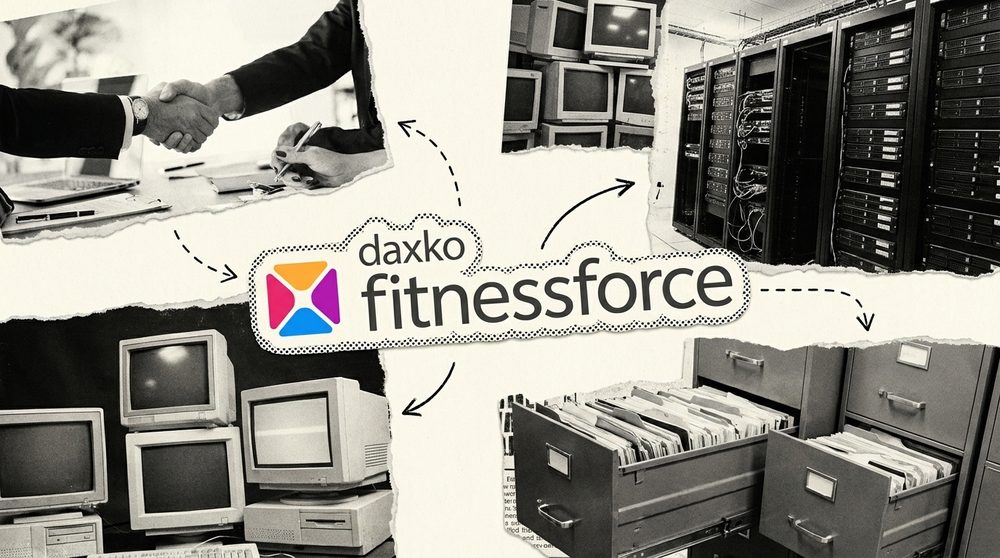
When Daxko announced its acquisition of FitnessForce last week, the press release did something unusual: it led with architecture.
Not customer count. Not revenue. Not geography — though FitnessForce does operate across 12 countries on three continents. The headline detail was that FitnessForce is an "API-first membership management platform" built on 1,100+ APIs and 50 webhooks. API-first: API-first: a software design approach where every function and data point in the platform is built as an API (Application Programming Interface) from the start, meaning external tools, integrations, and custom workflows can connect to it without special workarounds.
That's a strange thing to put in a press release. Unless it's the whole point.
The legacy problem Daxko hasn't solved yet
Daxko is the closest thing fitness software has to a conglomerate. Its portfolio now spans boutique studios (Exercise), mid-market health clubs (Club Automation, CSI, Motionsoft), martial arts (Zen Planner), and nonprofits (Operations). Combined, they serve 19,000+ locations across 55 countries.
| Platform | Segment Served | Architecture |
|---|---|---|
| Club Automation | Mid-market health clubs | Legacy |
| CSI | Mid-market health clubs | Legacy |
| Motionsoft | Mid-market health clubs | Legacy |
| Zen Planner | Martial arts | Legacy |
| Exercise.com | Boutique studios | Legacy |
| FitnessForce | Franchises, multi-region chains, international | API-first (modern) |
But most of that footprint runs on systems that were built before smartphones existed. Club Automation, CSI, Motionsoft — these are platforms operators use because they have to, not because they want to. The complaints are consistent: clunky integrations, limited API access, slow feature development, painful workarounds for anything custom.
FitnessForce is the opposite. It was built headless and API-first from the ground up — designed to connect to anything, move fast, and support complex operator structures like franchises and multi-region chains without custom workarounds. Every feature is an API. Every data point is addressable.
"Daxko didn't just buy a customer base. They bought a blueprint for how their entire portfolio should work."
— The Run RateWhat Daxko actually bought
The official rationale for the deal is international expansion. FitnessForce gives Daxko a foothold in India, the Middle East, Australia, and Southeast Asia — markets where fitness penetration is still low and the growth runway is long. CEO Jeff VanDixhorn put it plainly: "FitnessForce was purpose-built for how those operators actually run."
That story is real. But it's probably the second reason, not the first.
The more interesting read is this: Daxko bought a modern architecture it can use as a blueprint — or potentially a backbone — for modernizing the rest of its portfolio. When you acquire 1,100 APIs, you're not just buying the customers using them today. You're buying the capability to move faster across everything else you own. You're buying the ability to ship integrations in weeks instead of quarters. You're buying the foundation to connect an AI layer across your entire product lineup without rebuilding from scratch.
Whether that's the actual plan is unknowable from the outside. But the framing of the announcement — leading with the API count, not the ARR — suggests someone at Daxko understands what they really paid for.
The consolidation math for studio owners
Here's the more immediate concern for operators: this acquisition is one more step in the rapid consolidation of fitness software. Daxko, ABC Fitness, and a handful of other platforms are buying up the landscape. Each acquisition narrows the field of independent vendors competing for your business — and raises the switching costs for the operators already inside those portfolios.
The studios with the most leverage right now are the ones evaluating software before locking into long-term contracts. Once consolidation finishes its work, the negotiating window closes. The platforms that survive will have less pressure to compete on price, integration openness, or responsiveness — because there will be fewer places for an unhappy operator to go.
That's not a reason to panic. But it is a reason to read the fine print on your next renewal.
The execution question
Acquisitions have a way of producing ambitious integration roadmaps that quietly stall. The acquired team gets absorbed into the mothership. The "modern platform" gets positioned as a separate product line. The synergies remain in the deck but not in the product.
If Daxko executes — if FitnessForce's API architecture actually accelerates development across the legacy portfolio — the combined platform becomes meaningfully more competitive. Faster integrations, better third-party connectivity, and the ability to ship AI features across 19,000 locations is a genuine moat.
If they don't execute, it's a geographic expansion with a good press release. The fitness software market will have one more large platform with a complicated legacy stack and an international footprint it doesn't quite know what to do with.
Watch the product roadmap, not the announcement.
What does this mean for studio operators right now?
Consolidation doesn't hurt you the day it's announced — it hurts you at your next renewal. Daxko's portfolio now touches 19,000+ locations across 55 countries. ABC Fitness and a handful of others are buying up the rest. Every independent vendor that gets absorbed narrows your negotiating leverage and raises your switching costs. The window to evaluate alternatives, renegotiate contracts, and demand integration openness is open now. It won't stay open. Operators who treat software as a commodity until it's painful will find themselves locked into platforms that no longer need to compete for their business.