Pickleball is the fastest-growing sport in the United States and that fact has been reported to exhaustion. The part that has not been reported to operators is what the venues built around it are actually selling, because it is not what the signage suggests.
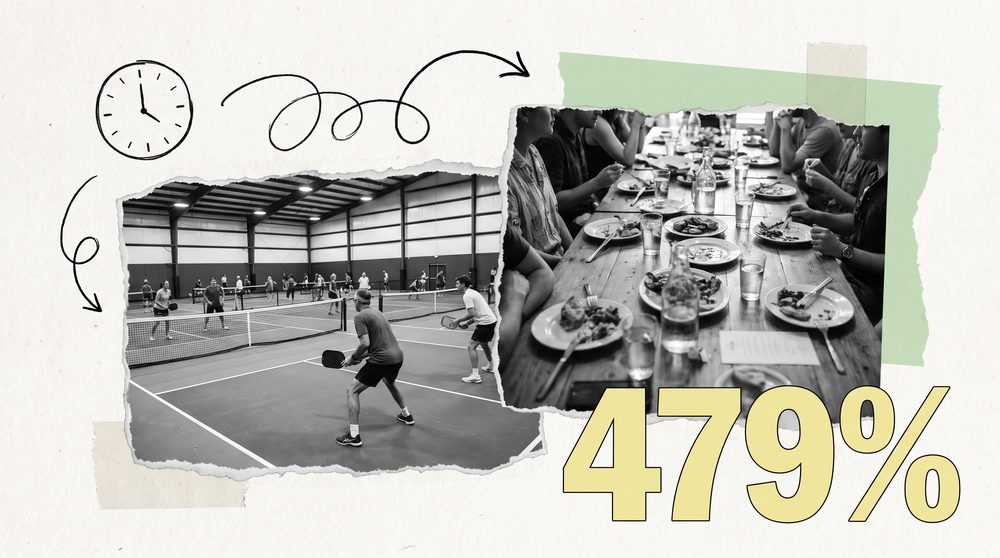
According to the SFIA 2026 Pickleball Single Sport Report, participation grew 479% between 2020 and 2025, reaching 24.3 million players. Over the shorter 2022 to 2025 window the figure is 171.8%. Both numbers are real and they measure different things, so treat any citation without a stated window carefully. The more useful figure for anyone building a facility is the committed core: players going eight or more times a year grew from 1.4 million in 2020 to 7.5 million in 2025. There are now 82,613 courts across 18,258 locations, with 14,155 added in a single year, roughly 39 a day.
What are pickleball venues actually selling?
Time in the building. Al Jazeera's report on the category quotes a consultant on the model directly: every one of these concepts makes its real money on the activity, the court fee, the lane, the simulator, and the food and beverage programme exists to stretch how long someone stays. The restaurant is not a profit centre pretending to be an amenity. It is an amenity that makes the profit centre work harder.
The numbers behind the model
The named operators are Chicken N Pickle, now at 13 locations across Texas, Missouri, Oklahoma, Kansas, Colorado, Arizona and Nevada, alongside Crush Yard, Pickle & Social and Electric Pickle, plus independents including The Sandy Pickle in Dallas, SPF Chicago and Sip & Pickle in Miami.
| Pickleball eatertainment venue | Typical boutique studio | |
|---|---|---|
| Footprint | 30,000 to 70,000 sq ft, often converted retail | 1,500 to 4,000 sq ft |
| Membership | $75 to $149/month | $150 to $250/month |
| Dwell time per visit | 90 to 120 minutes | 50 minutes, then the room turns |
| Revenue per visit | Court fee plus food, drink and retail | Class fee |
| Who they arrive with | Group of 4, usually mixed ability | Alone |
Read the bottom two rows together. A boutique studio charges more per month for a shorter visit that generates one line of revenue and is usually attended alone. A pickleball venue charges less, keeps the member twice as long, sells them a second and third thing while they are there, and they brought three friends.
The turn is the constraint studios never question
Dwell time (the total minutes a customer spends on site per visit, not the length of the service they bought) is a metric almost no studio tracks, because the class schedule makes it feel fixed. It is not fixed. It is a design decision that got made once and then hardened into an operating assumption.
The 50-minute class with a 10-minute turn exists to maximise sessions per room per day, which is the right optimisation when the room is the only thing you sell. The moment there is anything else to sell, that optimisation actively works against you: you are ejecting a customer at the exact moment their willingness to spend is highest.
This is the same arithmetic behind the shift toward revenue per member as the last lever left. When acquisition gets more expensive, the value of the member already standing in your building goes up, and pushing them out of the door on a timer starts to look like a choice rather than a necessity.
What this does not mean
It does not mean putting a café in a 2,000 square foot studio. The economics above are a function of footprint, and these venues are viable because 30,000 square feet of dead retail is cheap and a fitness studio's per-square-foot yield is high. Copying the amenity without the footprint gives you a coffee machine and a longer cleaning rota.
What is portable is the question. Where in your week does dwell time already exist, unmonetised? Most studios have one: the twenty minutes members spend in the lobby before an evening class, the Saturday morning that runs socially anyway. We found real demand hiding in the schedule when we looked at weekend night bookings, and the same instinct applies here. Virgin Active has been building the full-fat version of this for years, which we covered in the new country club.
One number to hold the enthusiasm in check: the willingness-to-pay evidence in the Al Jazeera piece comes from a 2019 SevenRooms study finding 21% of Americans would pay more at an eatertainment venue than a traditional restaurant. That is a seven-year-old figure covering a category that barely existed at the time. The dwell-time and footprint numbers are current. The spend-premium number is not, and nobody should build a P&L on it.