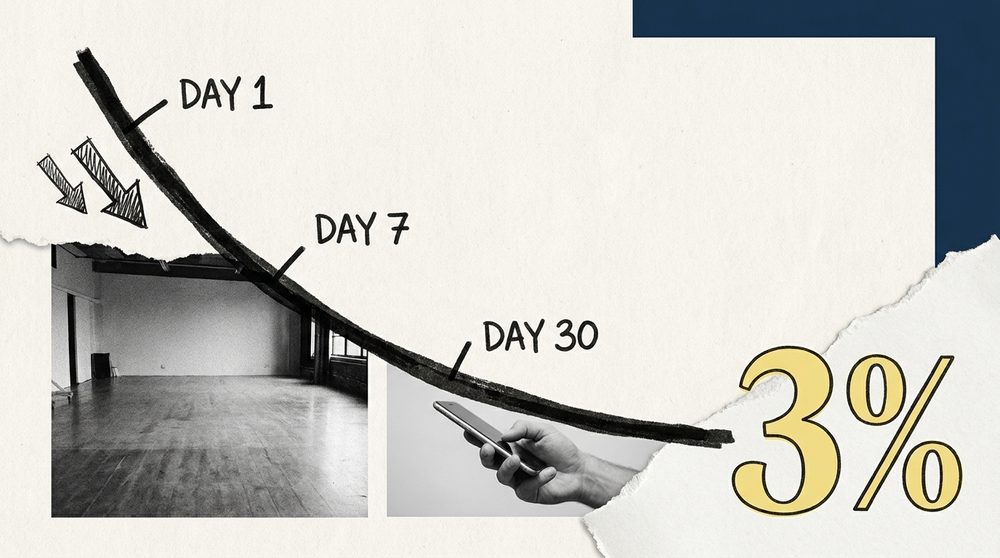
Health and fitness apps retain 3% of their users by day 30. Activation falls from 26% on day one to 10% by day 28. Annual subscription retention lands at 33%. Day one retention sits near 20%, and day seven between 7% and 8.5%.
A word on provenance, because it changes how you should use these figures. They were recirculated this week in a 2026 report from Fitness Refined, which is a compilation rather than new research. The underlying benchmarks come from Business of Apps and UXCam, and the headline 3% figure is 2023 data. The 77% three-day drop-off number circulating alongside it traces back to Quettra data popularized by Andrew Chen years earlier. Treat all of it as the shape of a curve rather than a fresh measurement. The shape is the useful part, and it has been stable for a decade.
The benchmark, laid out
| Metric | Health and fitness apps |
|---|---|
| Day 1 retention | ~20% |
| Day 7 retention | 7% to 8.5% |
| Day 30 retention | 3% |
| Activation, day 1 | 26% |
| Activation, day 28 | 10% |
| Annual subscription retention | 33% |
Read the first three rows again. Roughly four out of five people are gone within 24 hours. By the end of the first week, more than nine in ten. Everything that happens after day seven is happening to a small remainder.
Does a studio app improve member retention?
Not on its own. An app is a delivery surface. It carries booking, reminders, progress tracking and streaks to a member who has already decided to come back. It does not manufacture that decision. The category benchmarks make the point bluntly: apps built by well-funded product teams with dedicated engineers still lose 97% of users inside a month. A studio app from a software vendor will not outperform that curve simply because it has your logo on it.
Apps built by teams with more engineers than your studio has staff still lose 97% of users inside 30 days.
— The Run RateWhat the curve is actually telling operators
The steepest part of every retention curve sits in the first seven days, and that is true of app installs and gym memberships alike. This is the same finding that sits underneath our earlier work showing that 57% of studio members churn inside year one and most operators cannot say why. The churn concentrates hard at the front, in the window where a new member is deciding whether this is a thing they do now.
Activation (the share of new users who complete a meaningful first action, rather than merely signing up) is the metric that actually moves. Note what happens to it in the benchmark: 26% on day one, 10% by day 28. Most of that loss is people who never properly started.
South Korea gave us the cleanest natural experiment on the other side of this. A government programme that paid people to work out produced attendance that persisted after the payments stopped, because the payments ran long enough to build the habit. We covered it in why discounts do not keep gym members but habits do. The mechanism was frequency in the early weeks, not the incentive itself.
The first-week sequence that actually holds
What separates studios with strong retention is rarely their software. It is whether the first week is designed or left to chance. Four things to put in place:
Book session two before they leave session one. Not a reminder, not an email. A booked slot with a date on it. This single step moves activation more than any push notification sequence.
Target three sessions in the first seven days. Frequency in week one is the strongest available predictor of month-three attendance. Build the intro offer around session count, not calendar duration.
Make sure two humans learn their name. A coach and one other member. Social connection in the first fortnight is what converts an obligation into a routine.
Make the app carry the sequence, not replace it. This is the useful role for software, and it is a real one. The failure mode is adding app features to compensate for an undesigned onboarding, which is how you end up with the friction problem we documented when David Lloyd fixed its app overload at the cost of member experience.
One number to pull today
Of your last 50 joiners, how many completed three sessions within seven days? Most operators cannot answer without a manual export, which is itself the finding. That percentage predicts your twelve-month retention more reliably than any engagement dashboard, and unlike the app benchmark, it is a number you can actually move.