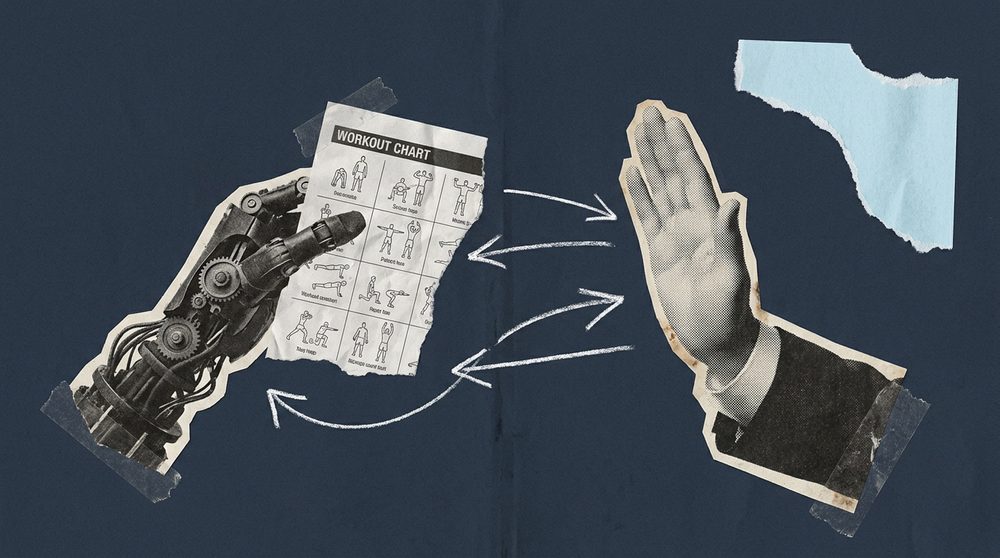
The AI workout plan is now free, instant, and everywhere. Ask ChatGPT for a 12-week hypertrophy program and you'll have one in eleven seconds — periodized, exercise-substitutable, adjustable by equipment access. The AI coaching wave already reached the gym floor at scale, and DIY programming apps have followed the same trajectory: cheap, fast, and good enough for the 80% of people who just need a plan, not a philosophy.
That's the commodity end of fitness now settled. What's left standing is the part AI genuinely cannot do: show up.
An algorithm can write you a leg day. It cannot notice you skipped Tuesday, text you before you talk yourself out of Wednesday, or high-five you when you hit the plate you've been chasing for six weeks. It has no relationship with your nervous system on a bad day, no read on whether you need to be pushed or pulled back. Programming is pattern-matching. Accountability is relationship. AI is very good at the first and structurally incapable of the second.
The mistake studios make is competing with AI on the wrong axis. Selling "expert programming" against a free app that also produces expert programming is a fight studios will lose on price every time. The product was never really the plan. It was always the person who noticed you weren't there.
AI can write the program. It cannot walk over and ask why you skipped Tuesday.
— The Run RateThe data on why this matters for retention is not subtle. Studios lose 57% of new members before month twelve, and the drop-off almost never traces back to bad programming — it traces back to members who stopped feeling seen. A generic plan doesn't create that feeling. A coach who clocks your form breaking down on rep nine does.
There's a version of this playing out in every category that AI touches first: the commodity layer gets automated, and the premium shifts to whatever the automation can't replicate. In software, that's judgment. In writing, that's voice. In fitness, it's presence — a specific, physical, repeated act of someone showing up for you when it would have been easier not to. Studios that understand this early have an advantage over ones still trying to out-program a free app.
Why does this matter for boutique fitness studios?
Because AI just deflated the value of the thing most studios lead with in their marketing — expertise and programming — while leaving the thing they've underpriced and undersold, accountability and community, completely untouched. Studios that keep selling "our trainers know more than an app" are competing on a shrinking asset. Studios that start selling "we notice when you're not here" are competing on one AI can't copy.
This isn't a hypothetical repositioning exercise. It shows up in what members actually respond to. The studios seeing the strongest retention right now aren't the ones with the most sophisticated periodization — they're the ones that have built a genuine social layer into the member experience, the same instinct behind the pushback against data-obsessed wearable culture: people are tired of optimizing alone and want to feel something with other humans in the room.
Practically, that means three shifts worth making this quarter:
Stop marketing your programming as the differentiator. If your ads lead with "certified trainers" or "science-backed programs," you're advertising the thing AI now gives away. Lead with the relationship instead — the instructor who knows your name, the class that texts you when you miss two in a row.
Build accountability into the product, not just the vibe. Attendance streaks, buddy check-ins, a coach who actually reaches out after a no-show — these are retention mechanics, not nice-to-haves. Most studios have this as a hope, not a workflow. A simple rule — anyone who misses two sessions in a row gets a personal text from a real staff member within 24 hours, not an automated app notification — will outperform almost any programming upgrade you could make instead.
Charge for presence, not for the plan. The pricing conversation should stop being about how good the programming is and start being about how much it's worth to have someone in your corner who notices when you disappear. That's a harder thing to commoditize, and members already sense it's worth more.
AI didn't kill the fitness studio's value proposition. It just stripped away the part that was never really the point, and made the part that was always the point impossible to ignore.