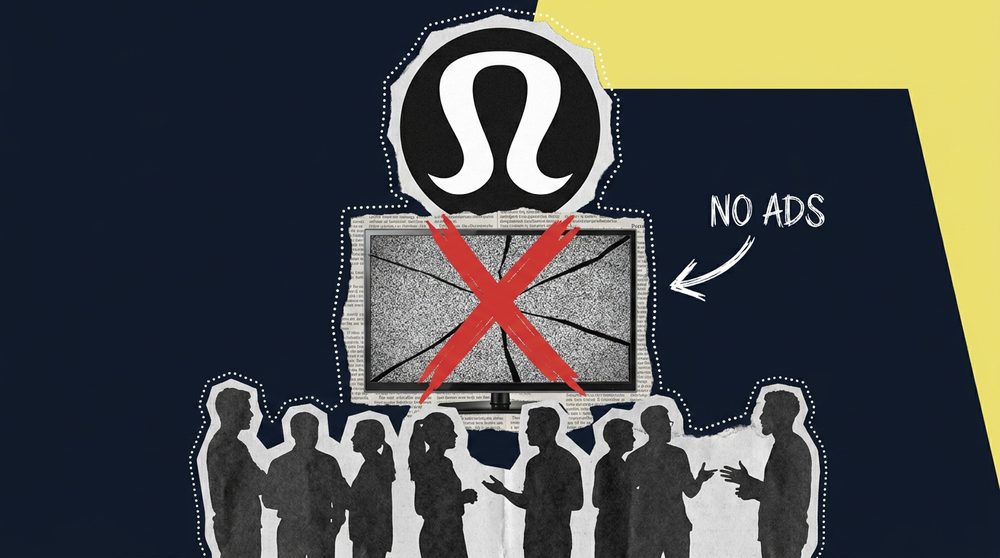
Lululemon has never run a traditional advertising campaign.
Not in their early years. Not when they scaled past $1B. Not today. No TV spots, no print, no paid social at scale. While Nike budgets hundreds of millions annually on media, Lululemon built a $10B business — with some of the highest gross margins in apparel — almost entirely without buying attention.
That's not an accident. It's a strategy. And the core mechanics of it are directly available to every boutique fitness studio that's currently burning budget on Meta ads and getting mediocre returns.
What happened
Two analyses surfaced this week examining how Lululemon — alongside CFMOTO and Vuori — used the same underlying playbook: obsessive focus on fewer products, absolute mastery of a narrow range, and community as the distribution engine instead of paid media.
The through-line across all three brands is the same: go so deep on one thing that the product sells itself. Then find the people who talk to everyone and give them something worth talking about.
The two-part playbook
Part 1: Depth over breadth.
Lululemon didn't try to make every piece of athletic apparel. They made Nulu fabric and Wunder Train tights and iterated on them obsessively until they were genuinely the best version of that specific thing. Customers who found the product didn't comparison-shop — because nothing else was quite the same. That specificity created pricing power and, critically, it made the product easy to describe and easy to recommend.
For fitness studios: what is the one thing you do better than anyone else in your market? Not "great instructors" — every studio says that. What specific, nameable thing? Your 6am reformer class that's always sold out? Your programming methodology that measurably improves mobility? The coach who's produced 12 competitive athletes? That specificity is your brand. The studios with the clearest answer to that question have the most pricing power and the highest word-of-mouth.
Part 2: Local ambassadors, not ad campaigns.
Lululemon's distribution model was simple: identify the 10–15 most connected fitness people in each local market — yoga teachers, run club leaders, personal trainers — put them on ambassador contracts worth a few hundred dollars and free product, and let them do what they were already doing: talk to their communities about fitness. Ambassador contract: Ambassador contract: a lightweight partnership agreement in which a brand provides free product, services, or a small stipend to a trusted community figure in exchange for organic advocacy — distinct from a paid influencer deal in that the ambassador is chosen for genuine local influence rather than follower count.
These weren't influencers with massive followings. They were connectors — people whose recommendations carried weight precisely because they weren't paid spokespeople. A yoga teacher who recommends a studio to her 20-person class carries more conversion weight than a billboard seen by 50,000 commuters.
"The ROI math is staggering. A $300/month ambassador contract probably generated more qualified customers than $300 of Meta ads does today."
— The Run RateWhy studios keep missing this
The reason fitness studios default to paid ads isn't because ads work better than community — it's because ads are easier to measure and easier to start. You can launch a Meta campaign in an afternoon. Building an ambassador network takes months and the results don't show up in a dashboard.
But the results show up in retention. Members who joined because a trusted person in their network recommended you stay longer, refer more, and complain less about price. Members who found you via a $15 lead ad have no particular loyalty to you over the next studio offering a Groupon.
| Factor | Paid Meta Ads | Local Ambassador Program |
|---|---|---|
| Time to launch | Same afternoon | Several months to build |
| Cost (monthly estimate) | $300+ in ad spend | ~$300 in product/stipend per ambassador |
| Measurability | Immediate dashboard data | Indirect — shows up in retention metrics |
| Member loyalty | Low — no prior relationship | High — joined via trusted referral |
| Year-one churn risk | Higher (primary churn driver) | Lower |
| Referral generation | Rare | Members refer others organically |
| Price sensitivity | High — vulnerable to Groupon competitors | Lower — pricing power from trust |
Lululemon understood that the path to pricing power and sustainable growth runs through community, not impressions. The studios that figure this out — and have the patience to build it — are the ones that will still be thriving in five years.
Three moves to steal this week
1. Identify your 5 local ambassadors — and activate them this month. Not social media influencers. Community connectors: the PT who sends patients to studios, the nutritionist whose clients are your demographic, the run club leader who knows everyone. Offer a free membership, early access to new programming, and genuine insider access. Ask for nothing explicit. The best ambassadors talk about you because they love what you do.
2. Cut your Meta budget by 30% and redirect it to experience. Run one experiment: take what you'd spend on a week of paid ads and use it to host a community event — a workout, a panel, a social. Track who joins in the following 30 days. Most studios will be surprised by the comparison.
3. Name the one thing you're genuinely best at — and make it the center of every conversation. Your website, your intake call, your instructor intros. Not "we offer a welcoming environment." Something specific: "We specialize in strength training for women over 40" or "Our reformer programming is designed around measurable mobility outcomes." Specificity is the prerequisite for word-of-mouth.
What to watch next
Lululemon is currently navigating a founder proxy fight and stock that's well off its peak. The challenges are instructive: category expansion into men's, international markets, and lifestyle diluted the precise focus that built the brand. Growth pressure pushed toward breadth, and breadth eroded the differentiation.
For boutique studios, the lesson cuts both ways. The playbook builds the brand. Protecting the focus — when every instinct pushes you toward adding formats, adding locations, adding offerings — is the harder and more important discipline.
The no-ads strategy isn't a budget constraint. It's a philosophy. And the studios that commit to it will build something that paid media can't buy.
Does the no-ads playbook actually hold up when studios need members fast?
Short-term, no — community-building doesn't fill a class by Tuesday. But the studios running pure paid acquisition are solving the wrong problem. Our data shows 57% of fitness studio members churn in year one, and the acquisition channel is a primary driver of that. Members sourced through trusted referrals retain longer, spend more, and generate their own referrals. Paid ads rent attention. Ambassador networks compound. The studios that are genuinely thriving past year three aren't the ones who cracked the Facebook algorithm — they're the ones who made paid media unnecessary.