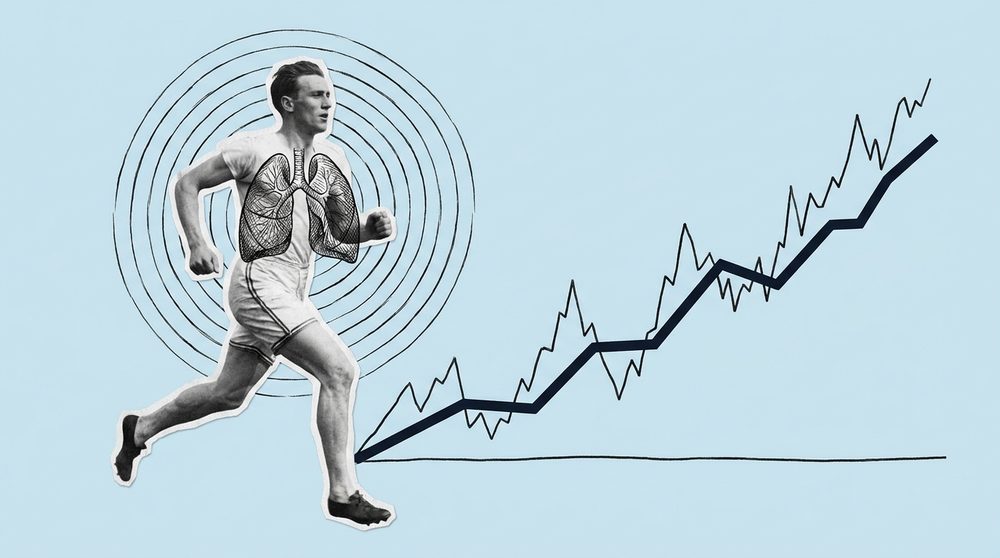
You can tell a health metric has crossed into mainstream consciousness by where it gets written about. VO₂ max spent decades in exercise-physiology labs and cycling forums. Last week it appeared in British Vogue's beauty section — with longevity physician Dr. Vicente Mera on record: "The higher the VO₂ max, the longer the life span, in both men and women."
First, the definition, because your members will ask. VO₂ max (maximal oxygen uptake) is the maximum amount of oxygen your body can use during intense exercise — in Mera's analogy, an engine's power rating measured by fuel consumption. The research linking it to lifespan is some of the most robust in exercise science: people with higher VO₂ max show a mean life expectancy roughly 4.9 years longer than those with lower scores, and in middle-aged men it's a protective factor against mortality independent of body mass index. Vogue passes on concrete targets, too — Mera suggests aiming for at least 35 ml/kg/min for men and 27 for women.
Cardio sold as calorie burn is a discount product. Cardio sold as measurable years of life is a premium one.
— The Run RateThe distribution layer is already in place, which is what makes this moment different from most wellness trends. Every mainstream wearable — Apple Watch, WHOOP, the Samsung Galaxy Ring — now estimates VO₂ max passively from a brisk walk or run. Dedicated training systems are building on top of it: apps like Morpheus pair daily HRV-based recovery scores with adaptive heart-rate zones aimed at building the aerobic base and recovery capacity that drive VO₂ max over time. The metric is on your members' wrists whether you program for it or not.
How should studios actually program for VO₂ max?
With a structured mix, not more random HIIT. The physiology rewards a large base of low-to-moderate aerobic work supplemented by genuinely hard interval sessions — and consistency over intensity theatrics. The NHS baseline of 150 minutes of moderate aerobic activity weekly is the floor, not the program. The studio opportunity is packaging: baseline assessment, zone-based programming, re-test every 8–12 weeks, and progress reported in a number members can watch move. That's a coaching product, a retention hook and a premium price point in one.
The positioning shift looks like this:
| Weight-loss era cardio | Longevity era cardio | |
|---|---|---|
| The pitch | Burn calories, lose weight | Add measurable years of healthy life |
| The metric | Scale weight, classes attended | VO₂ max trend over time |
| The programming | High-intensity everything | Aerobic base + structured intervals, recovery-aware |
| The proof | Before/after photos | Re-tested fitness-age improvements |
| Pricing power | Discounted class packs | Premium assessment-based coaching |
This is the same current TRR has been tracking for months: the longevity coach is displacing the personal trainer as the aspirational service tier, and longevity clinics are courting exactly the members boutique studios can't afford to lose. Those clinics charge four figures for testing panels with VO₂ max at the center. A studio with a bike, a heart-rate strap and a repeatable protocol can deliver the training side of that promise for a fraction of the price — and unlike the clinic, it sees the member three times a week.
The window matters more than the science, which has been settled for years. What changed is that the consumer glossies are now doing your member education for free. When Vogue tells its readers to start tracking a number, the smart operator's response is to be the place that helps them move it.
Cardio has been the loss leader of fitness for a decade. It just became the product.