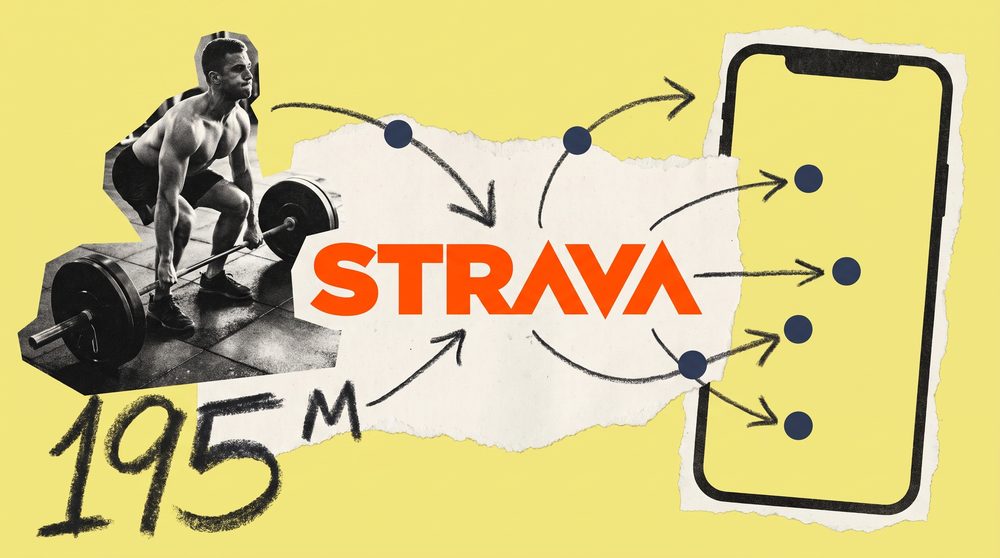
Strava rebuilt its strength training experience on 21 May 2026, adding 14 partner integrations, a dedicated workout log, auto-populated muscle maps and five strength-specific shareables. That was three months ago, and we are writing about it now for a reason buried in the launch partner list.
Alongside Amazfit, COROS, Fitbod, Garmin, Hevy, Jefit, Runna and WHOOP sits a line that reads differently to an operator: 24 Hour Fitness, scheduled to follow. A big-box chain is preparing to pipe its members' workouts into somebody else's feed.
The numbers behind the move
Strava is not a niche log. More than 195 million people use it, and strength is one of its fastest-growing activity types with over 500 million strength uploads in 2025 alone. CMO Louisa Wee told Marketing Brew the expansion follows strength becoming a larger part of people's lives, which is the same shift we tracked when strength overtook weight loss as the top stated gym goal.
For a decade Strava owned the record of what happened outdoors. The strength rebuild is a claim on the record of what happens indoors, on your floor.
What does this mean for gyms and studios?
It means the interpretation layer (the software that turns raw workout data into meaning for the member) is consolidating somewhere you do not control. When a member's session lands in Strava, the streak, the muscle map, the shareable and the social proof accrue to Strava's brand. Your studio becomes the venue named in a caption. That is not fatal, and for some operators the exposure is worth more than the ownership, but it is a decision worth making deliberately rather than discovering after a chain in your market has already made it.
The two ways to read the partner list
| Partner type | Examples | What they gain |
|---|---|---|
| Wearables | Garmin, WHOOP, COROS, Amazfit | Distribution for data the member already generates |
| Logging apps | Hevy, Jefit, Fitbod, Liftoff | Social layer they could not build alone |
| Coaching platforms | Caliber, Runna, iFIT Personal Trainer | Retention through visible progress |
| Operators | 24 Hour Fitness | Member-facing proof of work, and a data relationship they no longer hold alone |
The first three rows are software companies trading data for reach. The fourth is a gym, and gyms have historically been the ones charging for the relationship rather than supplying it. We flagged this dynamic when Strava filed to go public and argued the value was never the map, it was knowing the customer better than anyone selling to them. A public company with 195 million users and a strength log has a stronger claim on your member's fitness identity than your booking system does.
Why integrate anyway
Two honest arguments for saying yes.
Visibility is acquisition. A member posting a logged session with your studio attached is organic reach you did not buy, aimed at exactly the people a lookalike audience tries and fails to find. For an independent studio with no media budget, that is a real channel.
The alternative is not neutrality. Members are already logging elsewhere. If your sessions do not appear, the member's own record of their training simply omits you, and a training record with a gap looks like a period when nothing happened. Absence is a worse position than co-branding.
What to protect while you do it
Keep the parts that only you can do. Programming logic, coaching notes, intake history and progression plans are the assets that make a member hard to replace, and none of them belong in a public feed. Push the session record out and keep the interpretation in. That is the same split we described when Eli Lilly bought a piece of Oura, where the hardware mattered far less than who got to explain the numbers.
Also watch the attribution. If integration goes live and you cannot tell which joins came from it, you have handed over the data and kept none of the learning.
The timing
The feature is three months old and the operator partner has not fully landed yet, which makes this a rare thing in fitness tech: a shift you can still see coming. The chains are moving first because they have the integration budget. The window where an independent studio can be early to a 195-million-user platform closes when the category stops being novel, and on current cadence that is a 2027 problem being decided now.