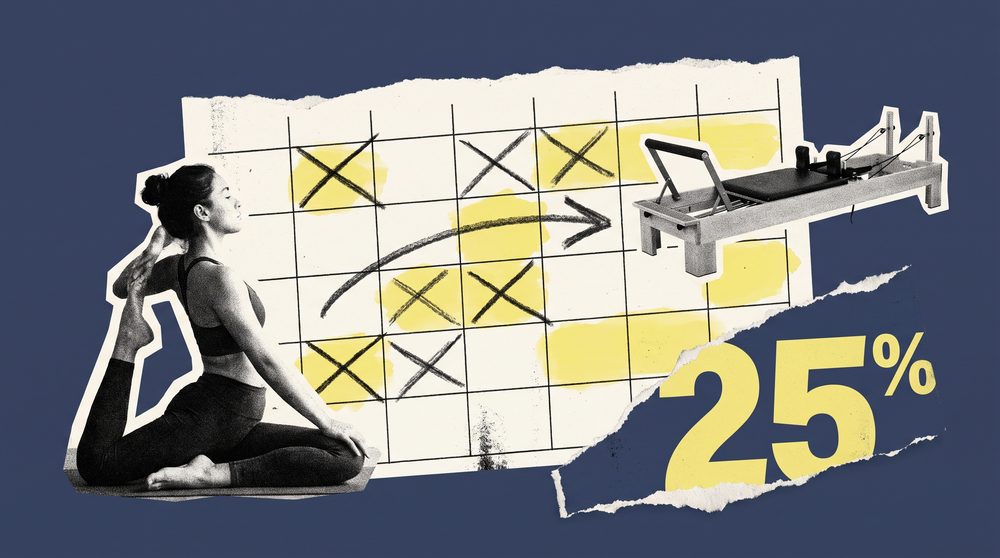
A former yoga teacher told The Atlantic last week that yoga is dead. She was being hyperbolic. The booking data says something more useful and considerably more uncomfortable for operators: yoga studios are staying open by selling less yoga.
Rheana Murray's piece pulled numbers from three booking platforms at once. Walla, the studio management system, said its "veteran" yoga studios, meaning those open more than three years, have cut yoga class supply by 25% this year. ClassPass said that in April, more than 40% of its yoga studios also took reservations for Pilates classes. Mindbody counted a 20%+ increase in yoga studios offering Pilates between 2023 and 2025.
Nobody ran a survey and discovered members wanted less yoga. Operators looked at a schedule, looked at a rent cheque, and reallocated the room.
Why does this matter for boutique studios?
Because format conversion has quietly become the default response to a soft membership market, and it is running faster than most operators are tracking. If two in five yoga studios in a national marketplace now sell Pilates, the differentiation a single-format studio was built on has already thinned. The competitive set is no longer other yoga studios. It is every studio within three miles that added a reformer this year.
The same move, in four segments
What the yoga data shows in isolation looks like a category in decline. Put it next to the rest of the month's news and it reads as one industry-wide manoeuvre. Women's Health gave it a name this week: rebundling (adding back the services a specialist brand originally stripped out to justify its premium).
| Segment | The move | The evidence |
|---|---|---|
| Veteran yoga studios | Cutting yoga, adding Pilates and sculpt | Walla: 25% supply cut in 2026. Mindbody: +20% offering Pilates since 2023 |
| Barre franchises | Launching Pilates-adjacent formats | Pure Barre relaunched Reform, a barre and Pilates hybrid. Bar Method and Physique 57 following |
| Big-box gyms | Buying boutique-quality classes | 24 Hour Fitness piloting reformer Pilates. Gold's adding HYROX turf |
| Boutique incumbents | Moving away from the crowded word | Solidcore dropped "Pilates" from its positioning in August |
That last row is the one worth sitting with. We covered Solidcore dropping the word "Pilates" a fortnight ago and read it as a pricing-power play. It looks sharper now. When every barre franchise, half the yoga studios and a big-box chain are all selling something they call Pilates, the incumbent's problem is no longer explaining the format. It is escaping it.
The membership numbers underneath
The conversion is not happening in a vacuum. Figures the Health & Fitness Association gave Women's Health put studio memberships at 24.9 million in 2019, 15.8 million in 2021, and 23.3 million in 2025, still roughly 6% below the pre-pandemic peak. Over the same recovery, fitness-only gyms grew membership 7.6% year over year in 2024 against 3.1% for studios. Between January and September 2025, traditional gym visits rose 4.2% while studio visits managed 0.8%.
So the studio segment is growing, slowly, while the segment it was supposed to have disrupted grows faster and takes the frequency. Adding a second format is a rational answer to that. It is also the answer everyone else is choosing at the same time, which is how a differentiator turns into table stakes inside eighteen months. We made a version of this argument when Pilates stopped being a workout and became a business model, and the platform data has now caught up to it.
What operators should actually do with this
Three things, in order.
Audit your own supply cut before you celebrate it. If you have quietly moved classes from your founding format to a hotter one, you have run the Walla experiment on yourself. Pull twelve months of schedule data and calculate what share of slots changed format, then check retention by member cohort against it. Members who joined for the original format and stayed through the switch are a different business from members you acquired after it.
Price the second format separately, at least internally. Conversion is usually justified on utilisation. Utilisation is not margin. A reformer room carries equipment cost, a smaller cap and a scarcer instructor pool, and the instructor market is the binding constraint most operators discover last.
Decide whether you are converting or hedging. Converting means committing the schedule, the marketing and the hiring to the new format. Hedging means running two half-committed formats and being the second-best option in both. The studios in the Atlantic piece that are doing fine made a call. Suzanne Davis, an Oregon yoga owner quoted in it, described adding lifting classes and wall-mounted resistance machines as a "no-brainer" and went at it properly.
The turn at the end of the Atlantic piece
Murray closes on something most coverage skipped. The Global Wellness Summit's 2026 report argues that "optimization itself has become a stressor," and Walla president Laura Munkholm said she knows plenty of people who have given up tracking altogether: "I don't care what the numbers are. I just want to live well."
That lands in the same fortnight as a reported $16 billion Oura IPO. Both things are true at once, and the operators who read only the first one will spend 2027 buying tracking hardware for a cohort that has started to opt out of being measured. We looked at the early version of that fatigue in wearable anxiety, and the college-age data we cover separately this week suggests it is not a niche.
Yoga did not lose. Yoga got outbid for its own floor space, by operators doing arithmetic. The question for the next twelve months is what outbids Pilates.