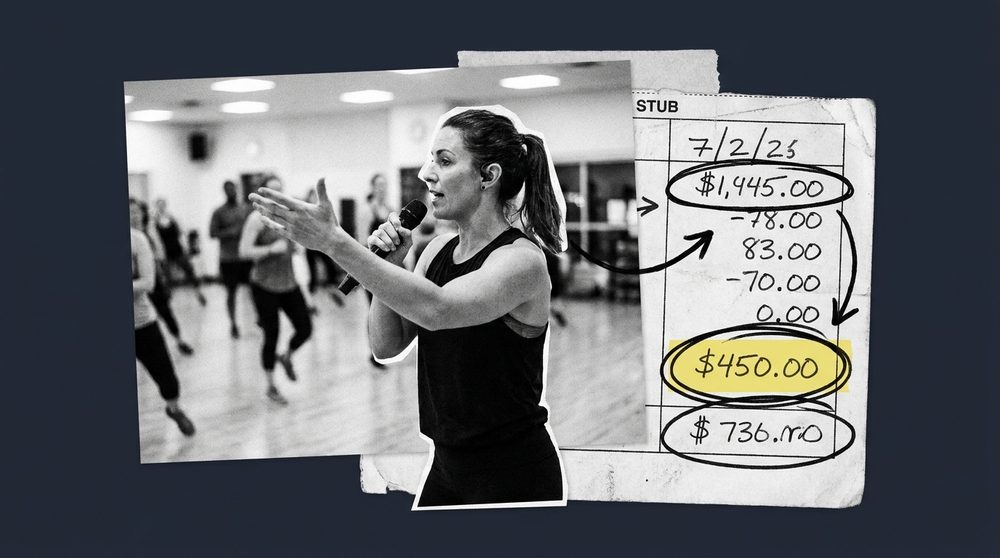
Three in four fitness instructors say they feel unfairly compensated, and it's not a vibes-based complaint. The 2026 SH1FT Instructor Report found many US and UK instructors haven't had a real raise in over a decade — accounting for inflation, that's a de facto pay cut every year it doesn't change. One 20-year US instructor put it plainly: "Pay isn't rising with inflation. I made $15 per hour when I started, now make $20. That's substantially less when adjusted for rising costs."
The instinct, watching CoverMe and Jobs In. Fitness build an entire recruitment infrastructure around the fitness industry's staffing gap, is to assume the fix is obvious: pay instructors more, across the board, and the retention problem solves itself. We don't think that's right — and the data backs up why.
What the Real Numbers Look Like
In the US, the most common pay bracket for a 30- or 45-minute class is $15–24; for a 60-minute class it's $25–34. That sounds survivable until you account for the roughly 100 minutes of unpaid prep, setup and cleanup wrapped around every paid class. Once that's factored in, the effective hourly rate (pay ÷ all hours actually worked, paid or not) drops to about $17/hour — against a $34 US median wage. Instructors aren't underpaid by a little. They're underpaid by half.
And it's not for lack of appetite to fix it from the instructor side: 85% say they're open to teaching something new, 58% identify as early adopters actively seeking innovation. But 21% say their own gym or studio won't support adding a new class format, even when they want to try one. The bottleneck isn't instructor motivation. It's studio permission.
Do Members Actually Choose a Class Because of the Instructor?
Sometimes — but not as often as owners assume. Attendance research consistently ranks convenience (location, schedule fit) and price above instructor as retention drivers for the average member. Instructor pull is real and measurable for a specific slice — the SoulCycle- or Peloton-style "star instructor" who members follow across studios or platforms — but for most classes, the instructor is a quality signal, not the reason someone walks in the door.
That's the flaw in "raise pay for everyone, fund it with higher prices": it taxes the majority of members, who came for the schedule and the price, to subsidize a benefit that only a fraction of them are actually paying for.
The Bifurcation Fix
The more defensible move isn't a blanket raise. It's splitting instructor compensation into two real tiers, the way Pilates studios rebuilt their business model around what members actually pay for instead of what the format used to be: treat your genuine draw-instructors — the ones members specifically book around — like talent. Higher pay, real programming latitude, even co-marketing under their name. Standardize everyone else: consistent choreography, predictable quality, lower cost, easily substitutable if someone leaves.
| Factor | Draw instructor (talent) | Standard instructor (commodity) |
|---|---|---|
| Who they are | Members book around them by name | Members book the time slot |
| Pay | Above market — priced like retention insurance | Market rate, consistent |
| Programming | Real latitude, co-marketing under their name | Standardized choreography, predictable quality |
| If they leave | Members follow them out the door | Easily substitutable |
| What the studio is buying | Differentiation + member retention | Margin + schedule coverage |
"Pay isn't rising with inflation. I made $15 per hour when I started, now make $20. That's substantially less when adjusted for rising costs."
US Group Fitness Instructor, 20 years in the industryThis is also a retention play, not just a labor-cost one. Instructor churn quietly compounds the same problem covered in why 57% of members churn in year one — members who bonded with an instructor who then leaves for better pay elsewhere are a flight risk themselves. Paying your actual draws enough to stay closes that leak; standardizing the rest keeps your cost base sane while you do it.
There's a pricing-power argument buried in here too. Equinox doesn't compete on price, it competes on identity — and a genuine talent-tier instructor is exactly the kind of identity a studio can charge a premium for. A commodity instructor teaching a standardized format isn't. Trying to pay both tiers the same rate means either overpaying for interchangeable labor or underpaying the person actually filling your room.
None of this solves the staffing pipeline problem CoverMe and Jobs In. Fitness are trying to fix from the hiring side. But recruiting faster into a compensation structure that's fundamentally flat and stagnant just moves the leak upstream. Fix the pay structure first, and the hiring problem gets smaller on its own.