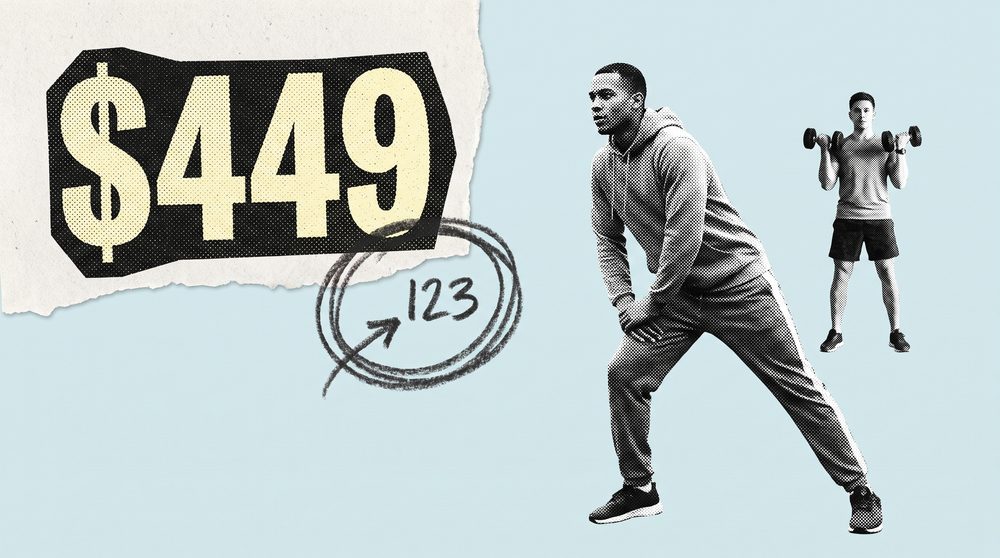
A new report says people taking GLP-1 medication spend $449 a month on fitness against $120 for everyone else. That is nearly four times as much, and it has been reprinted across the industry press in about seventy-two hours.
The number is real. The study is small in exactly the place the headline depends on, and the story most operators will take from it is not the one the data supports.
What the study actually did
The Consumer Collective, a consumer insights and advisory firm, fielded "How America Spends on Fitness" online in July 2026 among a national sample of 500 US adults aged 18 to 64. The GLP-1 findings rest on a subsample (the slice of a survey's respondents a specific finding actually rests on) of 123 users against 377 non-users.
Alongside the spending gap, it found 81% of GLP-1 users said they were likely to pay for a gym membership, against 43% of non-users.
Is the 4x figure trustworthy?
As a directional signal, yes. As a basis for repricing, no. A 123-person subsample carries a margin of error somewhere around nine percentage points, which is wide enough that the precise multiple should be treated as "substantially more," not as 3.7x. The larger issue is that GLP-1 access is expensive and skews toward higher household income, so the comparison is partly measuring wealth rather than measuring the effect of the medication on fitness behaviour. Some of the 4x is real. Some of it is the income of the people who can afford the drugs.
What it supports and what it does not
| The claim | Does the study support it? |
|---|---|
| GLP-1 users are a high-spending fitness cohort | Yes. This is the finding, and it is consistent across categories. |
| They are more willing to pay for a gym membership | Yes. 81% versus 43% is a wide, robust gap. |
| GLP-1 use causes higher fitness spending | No. The design is a cross-sectional survey with no control for income. |
| They will spend $449 at your studio | No. $449 is total fitness spend across categories, including equipment, apparel and apps. |
| You should raise prices for this cohort | No. Nothing here measures price sensitivity, only stated willingness. |
That fourth row is the one that will cost operators money. $449 is a basket, not a membership fee. It covers gear, supplements, apps and equipment along with facilities. Reading it as available membership budget is the same error we walked through in the retention benchmark guide, where widely quoted figures turned out to measure something adjacent to what everyone was using them for.
The part that is genuinely actionable
Strip out the multiple and a useful finding survives: this cohort is in an acquisition window and is telling you so. 81% stated willingness to pay for a gym membership is the highest of any segment in the report, and willingness that high usually means people are shopping rather than settled.
Three moves follow from that, none of which require the 4x to be precise.
Fix the intake question, not the price. Most studio intake forms still ask about goals in the language of weight loss. Members on GLP-1s are typically working on muscle preservation, strength and appetite-independent routine, which is a different programming conversation. We made the case for rewriting intake when strength overtook weight loss as the top stated gym goal, and this is the same fix reaching a new cohort.
Sell the thing the medication does not do. GLP-1s reduce weight, including lean mass. Resistance training is the recognised counterweight, and it is a service, not a discount. That framing supports a premium far better than any inference from a spending average.
Do not build a "GLP-1 programme" as a marketing label. The cohort is medicalised and cautious about being singled out. Programming, staff training and language matter more than a badge on the schedule. Our pricing guide covers why segment-specific tiers usually underperform a well-argued single price.
Why we are being pedantic about a good number
Because this is the third industry statistic this quarter that arrived pre-packaged and got repeated without anyone opening the methodology. The 4x will be in operator decks by October and in franchise sales material by Christmas, and by then nobody will be quoting the sample size alongside it.
Use it to justify attention on the cohort. Do not use it to justify a price. Those are different decisions, and only one of them is supported by 123 people answering a survey in July.