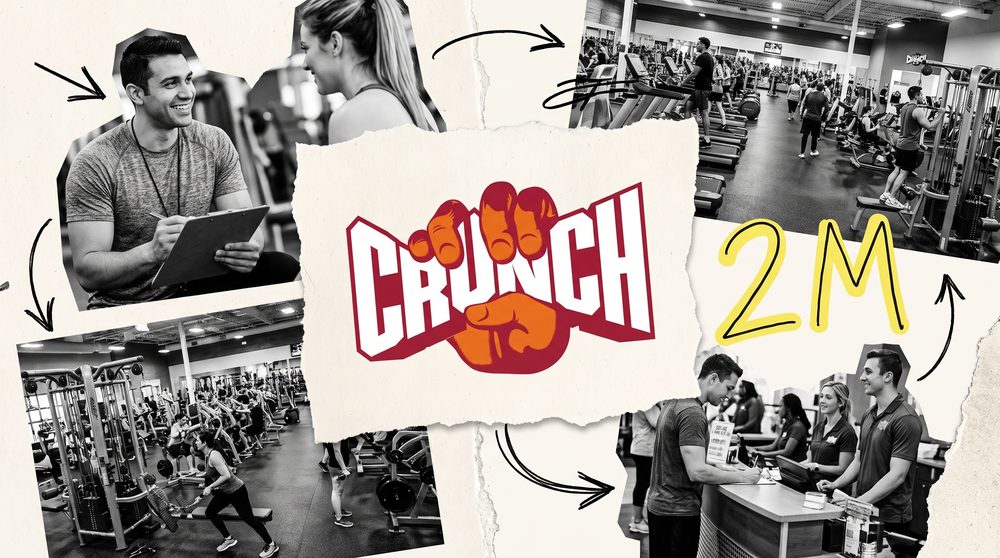
CR Fitness Holdings is not Crunch corporate. It is one franchise group that happens to own 98 Crunch Fitness clubs, which makes it among the largest Crunch operators in the country. On Saturday August 29, it will offer every member across those 98 clubs two complimentary 30-minute personal training sessions. The franchisee operates in Florida, Texas, Georgia, North Carolina and Tennessee, and counts more than a million members. Two sessions each comes to two million sessions, which is the number in the press release.
They have done this before. The same franchise group ran 1.2 million sessions in 2024 and 1.6 million in 2025. TRAINing Day has become an annual mechanic, and it keeps getting bigger.
How many members actually redeem a free personal training session?
Nowhere near two million, and the constraint is physical rather than behavioural. On a TRR estimate, 98 clubs each staffing ten trainers running back-to-back 30-minute sessions across a 16-hour day reaches a ceiling of roughly 31,000 sessions, about 1.5% of the number advertised. That is the arithmetic: 10 trainers times 32 slots times 98 clubs. The two million figure describes what members are entitled to, not what gets delivered, and treating it as a forecast would lead any operator copying it badly astray.
We are flagging that gap because it is the most useful thing in the story. The promotion is not built to deliver two million sessions. It is built to create one day where a very large number of members walk past a trainer who is expecting them, and where saying yes costs nothing and takes half an hour. The advertised number does the marketing work. The capacity does the sales work.
Why one day beats six months
Most gyms already give away personal training. It sits in the welcome email as a complimentary session, redeemable any time, and it dies there. A benefit with no deadline and no physical prompt converts close to nothing, because the member never reaches a moment where claiming it is the obvious next action.
TRAINing Day inverts every part of that. The window is a single day, which manufactures urgency without a discount. Sign-up happens at a Personal Training Bar inside the club, so the member is already in the building and the trainer is already in front of them. And the whole staff is running the same play at the same time, which turns it into an event rather than a transaction.
That last part is what makes the attach rate (the share of members who add a paid service on top of their base membership) move. Personal training is the highest-margin attach most gyms have, and the barrier is almost never price. It is that the member has never been coached by that person and has no idea whether they would like it.
What the conversion data says
The public benchmarks on trial conversion are messy, and operator reports range from roughly 10% to over 70% depending on what is being counted. The patterns that hold up across sources are these.
| Approach | Reported conversion |
|---|---|
| Paid intro offer (two weeks to one month) | 60-80% |
| Free trial | 30-45% |
| Trial lasting 17-32 days | 45.7% median |
| Trial lasting 4 days | 26.8% |
The through-line is that structure beats generosity. Operators who consistently convert at the top of these ranges treat a trial as a designed sales process with scheduled touchpoints, not as an open-door hospitality experience. Free converts worse than paid, and short converts worse than medium, and both of those findings are about commitment rather than about value.
Which is why the CR Fitness design is smarter than the headline suggests: it is free, which maximises sign-ups, but it is compressed to one day and delivered in person, which restores the commitment that free usually removes.
Running your own version at studio scale
You do not need 98 clubs. You need one Saturday.
Size it from your capacity, not your member list. Count trainers, multiply by available slots, and that is your real offer. Four trainers across eight hours at 30 minutes each is 64 sessions. Offer 64, not "free training for everyone."
Make scarcity honest. 64 slots is a genuine constraint and it does the urgency work for you. A fake deadline on an unlimited offer trains members to ignore your deadlines.
Put the sign-up in the room. A table by the door on the day, staffed. Not a booking link. The entire mechanic depends on the member and the trainer being in the same physical space when the decision gets made.
Decide the next step before the day. The session is an audition rather than a product. Every trainer should finish with a specific recommendation and a way to book it. Without that, you have run a free class.
Target lapsed members, not just actives. A member who has not scanned in six weeks is the highest-value invitation you can send, because you are competing against a cancellation that has not happened yet. We have written about how most operators cannot explain why 57% of members churn in year one, and a face-to-face half hour is the cheapest diagnostic available.
One caution. As AI has driven the price of programming toward zero, the free session cannot be a demonstration of programming, because a member can get a plan from a chatbot for nothing. It has to be a demonstration of a person paying attention. That is the part that is still scarce, and it is the only thing worth auditioning.
CR Fitness will not deliver two million sessions on Saturday. It will deliver a fraction of that, and it will be a very good day for their business anyway. The mechanic is what to copy, and the mechanic costs one Saturday and some staffing.