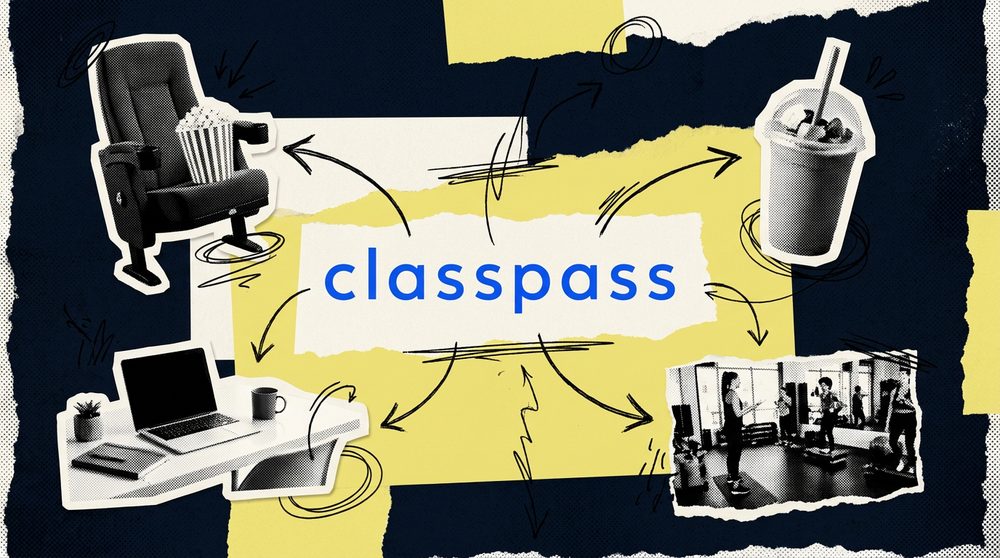
ClassPass will now spend your credits on a movie ticket. In 2025 it added standard 2D showings at AMC theaters across California, Florida, Texas and Arizona. Around it sits a growing shelf of things that are not a workout class: smoothies from SunLife Organics in ten cities, salon and spa appointments, WeWork day passes, concert tickets, and a 2026 creative-activities category that spends credits on group painting. Fitness, the thing ClassPass was built on, is now one category among many.
The reflex read is betrayal. Studios supplied the discovery inventory that made ClassPass valuable, and ClassPass is now using that audience to sell everything else. But betrayal is the wrong frame, because nothing here is a surprise. This is simply what a marketplace does the moment it has leverage. It commoditizes its own supply.
Why is ClassPass adding movies and smoothies?
Because it can, and because the economics point that way. A marketplace makes more money as members spend more credits, regardless of what they spend them on. Once ClassPass owned the member relationship and the habit, fitness stopped being the product and became the acquisition hook. Its parent now sits inside a $7.5B merger with EGYM and Mindbody, and ClassPass made TIME's Most Influential Companies list in 2026. That is the leverage. Adding categories is how leverage gets monetized.
Fitness was never ClassPass's product. It was ClassPass's onramp.
— The Run RateWe wrote a while back that ClassPass trained consumers to expect optionality, and studios are paying for it. The lifestyle expansion is that same behavior taken to its conclusion. The member who learned to treat fitness as an interchangeable credit is now learning to treat the whole ClassPass wallet that way. A spin class and a smoothie draw from the same balance. The studio becomes one line item in a lifestyle subscription it does not control.
Should fitness studios leave ClassPass?
No, but stop treating it as a growth channel. ClassPass is useful as cheap top-of-funnel trial traffic, a way to fill off-peak classes and get first-timers through the door. It is a poor foundation for a business, because you do not own the member, the data, or the pricing. Use it deliberately: cap the inventory you expose, convert ClassPass visitors into direct members fast, and reduce reliance over time. The operators who get hurt are the ones still calling a marketplace their acquisition strategy years after the marketplace stopped prioritizing them.
| ClassPass | Owned funnel | |
|---|---|---|
| Who owns the member | ClassPass | You |
| Member data | Limited, platform-held | Yours in full |
| Pricing control | Marketplace sets it | You set it |
| Best use | Cheap trial traffic to convert | Your growth strategy |
The tell is the opportunity. When ClassPass leans into movies and coworking, it is signaling that defending fitness margins is no longer its priority. That is useful information. It means the smart operator should be building owned funnel streams in parallel, the ones a marketplace can never take: an email list, a referral engine, a local brand that people seek out by name.
Most studios cannot answer a basic question here, which is where their members actually come from. As we found in the attribution piece, operators consistently misjudge their real acquisition sources, and the ones who measure honestly discover that roughly 80% of new members come from three owned channels, not the marketplace they over-credit. If ClassPass is quietly de-prioritizing fitness, the operators who already know their owned CAC (Customer Acquisition Cost, the total spend to acquire one paying member) are positioned to shift budget and attention before the traffic dries up.
None of this requires a dramatic exit. Marketplaces are a legitimate channel when used as a channel. The mistake is dependence. A studio that gets 40% of its trials from ClassPass and converts 8% of them into direct members is renting an audience it could be buying outright. A studio that gets 10% of its trials from ClassPass, converts hard, and grows a name locally is using the marketplace the way it is meant to be used, as a supplement, not a strategy.
ClassPass adding a smoothie category is not the story. The story is what it reveals. A platform is telling its fitness supply, politely and in the form of a product update, that the relationship has changed. The operators who hear it and diversify will be fine. The ones who keep treating a lifestyle app as their growth plan are building on ground that is already shifting under them.