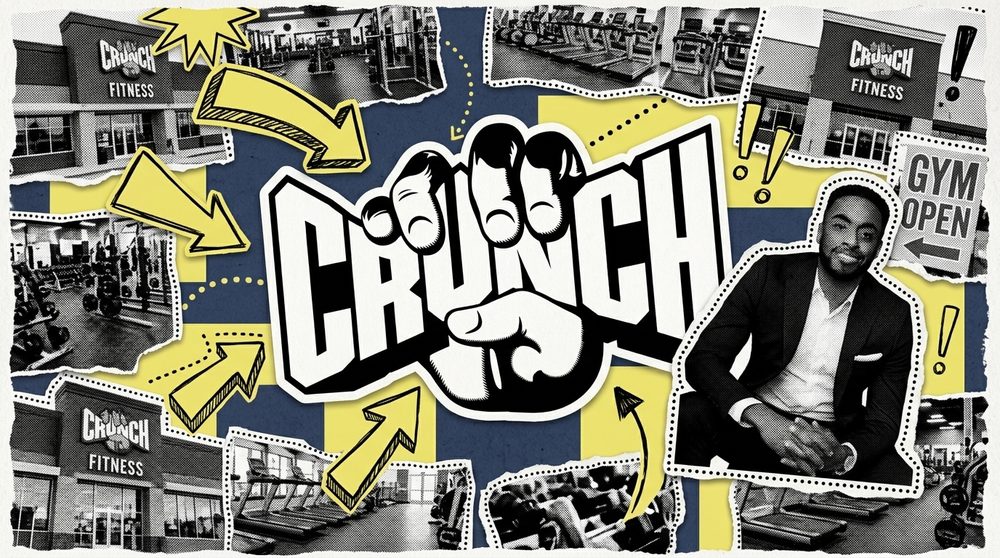
Crunch Fitness just appointed Chequan Lewis as CEO. For most people outside the fitness industry, this is a line in a press release. For boutique studio operators, it's worth reading more carefully — because who leads a 400-location chain, and the strategic bets they make in their first year, shape the competitive landscape every independent operator is working inside.
Lewis comes with a background that signals something about where Crunch wants to go. A Howard University alumnus with experience in franchise growth and brand strategy, his appointment follows a period where Crunch has been trying to occupy an increasingly difficult middle ground: too expensive to beat Planet Fitness on price, not premium or specialized enough to compete with the best boutique studios on experience. That positioning trap is the central challenge any new Crunch CEO inherits.
What Crunch is actually competing for
Crunch's price point — roughly $25 to $35 per month for base membership — puts it in a tier that the market has been slowly squeezing from both sides. Planet Fitness keeps winning on price clarity ($10 or $25, no confusion, massive marketing). Boutique studios keep winning on specificity and outcomes. Crunch has historically tried to be the in-between: more equipment and amenities than Planet Fitness, more affordable than SoulCycle or Orangetheory.
The problem with the middle is that it requires a clearer story than either extreme. "More than bare-bones, less than boutique" is a positioning that works as long as the consumer is actively comparing price. The moment they're comparing experience, outcomes, or community, the middle loses.
| Dimension | Planet Fitness | Crunch | Boutique Studio |
|---|---|---|---|
| Price point | ~$10–$25/month | ~$25–$35/month | ~$100–$200/month |
| Primary differentiator | Price clarity | Amenities + affordability | Experience, outcomes, community |
| Class programming | Minimal | Growing | Core product |
| Coach relationship | None | Limited | Central |
| Scale advantage | Very high | High | Low |
| Community depth | Low | Low–moderate | High |
Every new CEO at a major chain is either a threat or an irrelevance to boutique studios. The danger is assuming it's the latter without checking which direction they're moving.
— The Run RateThe two scenarios studios should watch
Lewis's strategic options narrow to two meaningful directions. The first is doubling down on value and scale — more locations, tighter pricing, better equipment, leaning into the franchise model's unit economics unit economics: Unit economics: the direct revenues and costs associated with a single franchise location, used to assess whether the business model is profitable at the individual unit level before scaling.. This is a Planet Fitness fight, not a boutique fight. If Crunch goes this direction, independent studios face less direct pressure than they might assume; Crunch is hunting a different member profile.
The second direction is the one that boutique operators should actually watch: Crunch moving upmarket. More class programming. Instructor-led formats. Community events. Technology integration. A stronger brand voice. If Lewis brings a community-forward strategy — which his background might suggest — Crunch could start competing more directly for the member who's currently choosing between a $30/month Crunch and a $150/month boutique studio. That's a much more interesting competitive move, and a real one.
What independent studios can't be beaten on
The honest answer is that a well-run boutique studio at 10 to 30 locations can't out-scale Crunch, and shouldn't try. The competitive moat is everything that doesn't scale linearly with location count: the coach who knows your name and your injury history, the community that texts you when you miss a week, the programming that's built around a specific outcome rather than general fitness.
Crunch can add group fitness classes. It cannot add the relationship between a member and a coach who has been tracking their progress for two years. It can add community events. It cannot add the belonging that comes from being known in a small room by people who share your specific goal. Scale is Crunch's advantage and its ceiling at the same time.
Lewis's appointment is worth watching because it signals a strategic inflection at a chain that has real reach. But the right response for boutique operators isn't anxiety — it's clarity. Know exactly what you offer that a 400-location chain structurally cannot replicate, and build every acquisition and retention touchpoint around that. Whoever ends up running Crunch, that calculus doesn't change.
What should boutique studio operators actually do in response to Lewis's appointment?
Nothing reactive — but something deliberate. Map your retention and acquisition touchpoints against what Crunch can structurally replicate at scale: class formats, equipment, pricing tiers. Then identify what's left. That remainder — the coach relationship, the specific community, the outcome-driven programming — is your actual product. If you can't articulate that difference in one sentence to a prospective member choosing between your studio and a $30/month gym, Lewis's strategic direction becomes irrelevant. The threat isn't Crunch's new CEO. It's boutique studios that haven't made their moat obvious enough to matter.