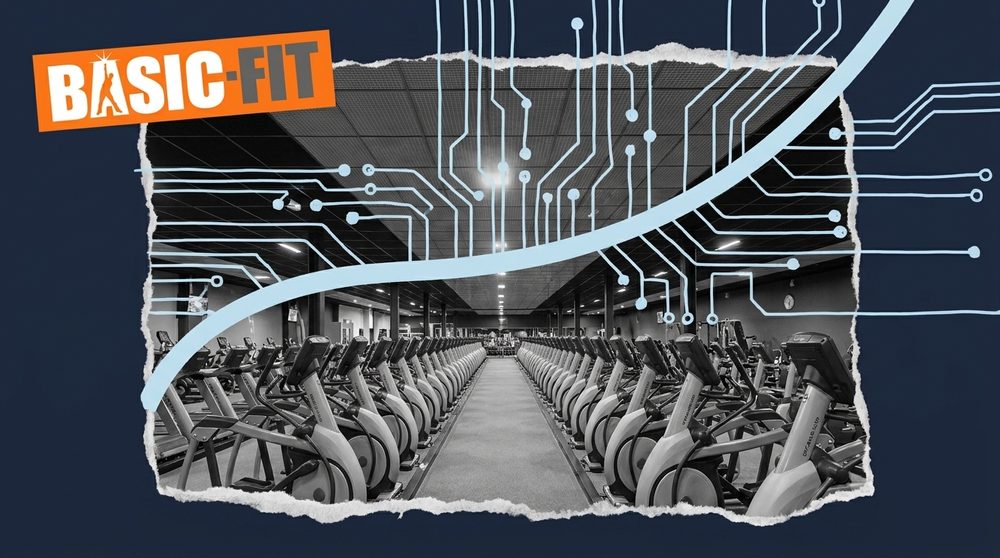
For a decade, Basic-Fit's growth strategy was essentially a construction schedule. The Dutch low-cost operator opened clubs faster than any competitor in Europe — at its peak, a new location roughly every 36 hours — on the logic that whoever secured the sites first owned the market. By Q1 2026, per its own trading update, that machine had produced 2,184 clubs, 6 million members, and quarterly revenue of €396 million, up 19% year over year.
Which makes the next number remarkable: for 2026, Basic-Fit plans roughly 50 new club openings. Not 500. Fifty.
Read the cash line before calling it a retreat. Alongside the slowdown, Basic-Fit posted the first positive free cash flow in its history — €26 million, against negative €88 million just a year earlier — and raised its 2026 EBITDA (earnings before interest, taxes, depreciation and amortization) guidance to €415–455 million, per its investor results. The company that defined the land-grab era just declared it over.
The land-grab era optimized clubs opened. The efficiency era optimizes value per member.
— The Run RateWhere does Basic-Fit's growth come from if not new clubs?
Three places: franchising, AI and data. The expansion model is shifting from owned clubs to capital-light franchising — the Clever Fit acquisition gives Basic-Fit franchise infrastructure across Europe without construction capex. Inside the clubs it already owns, AI-driven personalization in the app tailors workouts and nutrition from member data, working the retention side of the ledger. And club-usage data now drives site layouts and new-location ROI decisions, laid out in the company's Capital Markets Day strategy. Growth didn't stop — it moved from the balance sheet to the installed base.
The strategic table looks like this:
| Land-grab era (2015–2024) | Efficiency era (2025→) | |
|---|---|---|
| Headline metric | Clubs opened per year | Free cash flow, EBITDA margin |
| Capital model | Owned clubs, heavy capex | Franchising, capital-light |
| Technology's job | Access control, cost cutting | AI personalization, usage data driving site and layout decisions |
| Growth lever | New markets, new sites | Monetizing 6M existing members |
This is the same turn the connected-fitness players made after their own growth-at-all-costs phase collapsed — Peloton's pivot from hardware growth to subscriber economics was forced; Basic-Fit's is voluntary, made from a position of strength, which is precisely why it's the more important signal.
For independent and boutique operators, the instinct is to shrug — you were never opening 300 clubs a year. Wrong read. When the largest operator in your market stops competing on presence and starts competing on data-driven member value, the competitive bar moves for everyone. Basic-Fit at €22.99 a month with an AI coach in the app is a different animal than Basic-Fit as a warehouse of equipment. The premium end of the market is running the same play with different branding — Virgin Active is rebuilding itself as a social wellness club — and both converge on the same thesis: the next fitness cycle is won on revenue per member, not members per club.
The uncomfortable question for operators of every size: if the biggest player in Europe decided its own footprint was the wrong thing to optimize, what are you still optimizing that no longer matters? Membership counts flatter the ego. Cash flow per member pays the rent.
Basic-Fit spent ten years proving fitness could scale like retail. It's about to spend the next ten proving it should operate like software.